

A Quicker Resolution

Markets cheer the ceasefire, but investors must game out what the structural changes will be when the US and Iran reach a compromise. For one, the US itself, whose international position may have been weakened by the way the President managed the war communication.
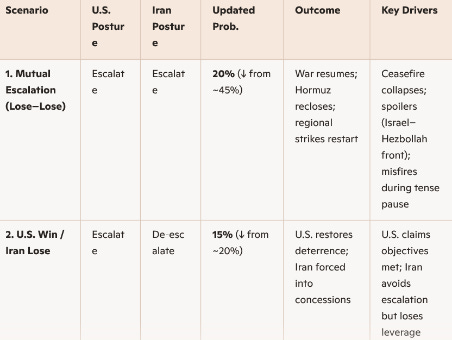
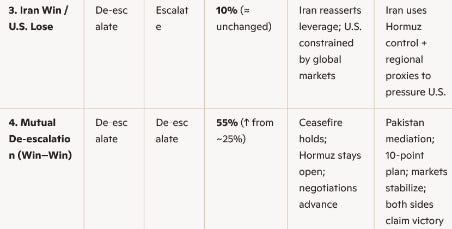
There is a plausible scenario in which the US and Iran will reach an agreement sooner, as indicated by Trump’s tweets that the US “will work closely” with Iran, suggesting that an expedited path to full resolution may become a reality. This is reflected in a material shift: the odds of de-escalation have risen to 55% based on this particular ceasefire (see Table 10.
Table 1: Updated odds of escalation/de-escalation (%)
Source: FedWatch LLM
For markets, this ceasefire is an epic Taco trade because it was Pakistan that was able to convince Trump that Iran’s 10-point plan is a workable basis, even though Iran wants to maintain control of the Strait. Trump’s abyss rhetoric did not lead Iran to capitulate, while the relationship with NATO was substantially weakened.
That said, even though Trump declared victory overnight, the tweet shows how far apart the two parties are. In contrast, the Iranian 10-point plan emphasizes a continuation of enrichment of uranium; Trump claims in his latest tweet the opposite (!).
Iran had been enriching uranium to 60% at Natanz and Fordow since 2021. This is the highest level Iran had publicly acknowledged, and the IAEA had verified, albeit not enriching at 90%, which is weapons-grade. Iran also continued producing 20% enriched uranium, a level it first resumed in 2021.
But its uranium stockpile, according to the IAEA, was 120-130 kilograms of 60% enriched, and several hundred kilograms of 20% enrichment. These stockpiles are buried under the Fordow Fuel Enrichment Plant (FFEP) and the Natanz Fuel Enrichment Plant (FEP + UGF).
Iran and the US are unlikely to agree on ending enrichment, except for a potential reduction from 60% to 20%, or even to 3.67% (the JCPOA limit).
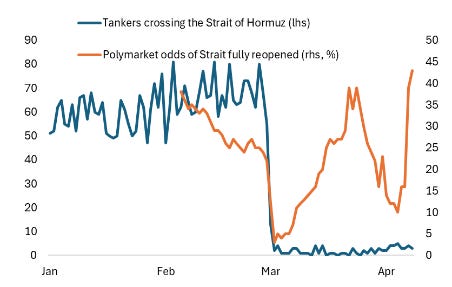
Nonetheless, the resumption of traffic in the Strait and moderation of enrichment take out the macro tail risks of the conflict—i.e., the rising odds of a full reopening of the Strait, now at 44%—so today is “time to buy,” ironically—part 2. (See Figure 2).
Figure 2: Tankers crossing the Strait and Odds of reopening (%)
Source: Polymarket, Bloomberg Hormuz Tracker
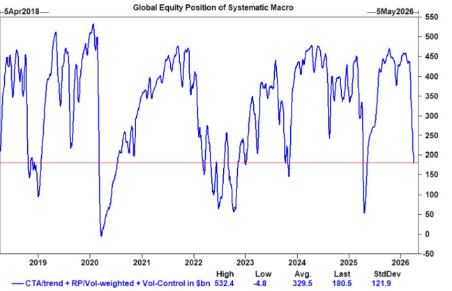
From an investment strategy perspective, the opportunity may initially lie in the leveraged beta. This crisis materially reduced liquidity even as markets remained functional. Instead, CTAs, systematic and long/short macro hedge funds washed out leveraged equity positions, which are now at attractive entry levels (see Figure 3).
Figure 3: Washed out leveraged equity positions ($, billion)
Source: Goldman Sachs
Call option volumes on leveraged Tech ETFs were already rising ahead of a ceasefire, anticipating an end to this conflict one way or the other. Secondly, a rotation from energy into financials, materials, staples, and even small-cap Tech growth stocks is firmly underway.
Bonds and Gold spring back to life, notably European sovereigns (down 22 basis points), and now-battered BDCs and regional bank preferreds are jumping as credit fears ease on the prospect that inflation will moderate over the next few months, avoiding a potential recession in the US.
A couple of notes, I introduced the “war portfolio” and “rebound portfolio.” The concept was to play defense by overweighting energy, Gold, cash, and Bitcoin as alternatives, while pre-positioning for a rebound because it became clear early on that Trump was taking the initiative to de-escalate.
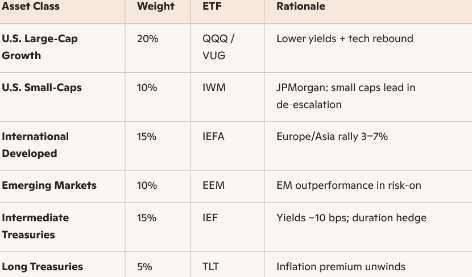
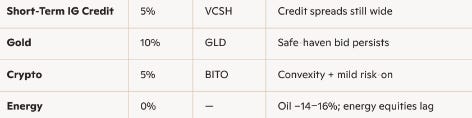
Now I let the FedWatch LLM model triangulate a new model ETF portfolio that reflects the new ceasefire regime, incorporating the actual market reactions across equities, oil, yields, and credit spreads.
The ceasefire creates a risk‑on impulse, but not a full unwind of hedges. This means the optimal portfolio is barbelled: add growth cyclicals, reduce energy, keep gold/Treasuries as partial hedges, and avoid lower‑quality credit.
Figure 4: New ETF model portfolio based on the ceasefire
Source: FedWatch LLM