

A Yen Intervention for Oil

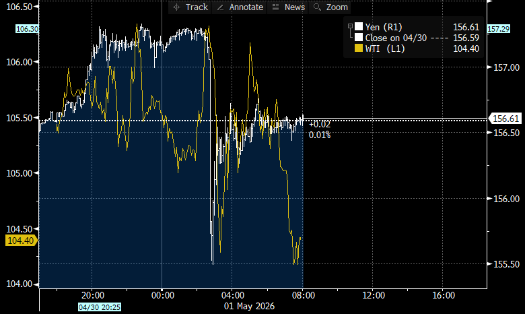
An intervention in the Yen amounted to $34 billion USD, according to the BoJ’s current account data. The Yen moved two “big figures” (from 157 to 155 against the USD), and that helped “stabilize” oil to the downside. This is the first sign that recently established correlations between oil, stocks, currencies, and rates are changing, which may imply directional shifts in broad markets.
More interventions loom as the US naval blockade persists, while the Administration argues that the ceasefire allows it to bypass Congress. As the blockade tightens its grip further, Japan could be at the global macro nerve center.
Figure 1: Overnight price action: Yen for Oil
Source: Bloomberg
If Japan loses ~half or more of its Hormuz-linked crude flows for longer than a few months, at oil prices 40–60% above pre-shock levels, the trade-balance impact likely crosses from “painful but manageable” into “intolerable” in a macro sense.
About 95% of Japan’s crude imports come from the Middle East, and roughly 70% of Japan’s oil imports and 6–11% of LNG imports transit through the Strait of Hormuz. Higher oil prices and volumes lost through Hormuz hit the Japanese trade balance (import bill), corporate margins (petrochemicals, transport, power), and real incomes via fuel and electricity costs.
Japan exemplifies what Chevron’s CEO, Mike Wirth, said about near-term oil dynamics: energy demand will decline if supply is not reestablished, or it will cause permanent shifts in the energy supply chain, such as Australia securing oil imports from a broader range of countries.
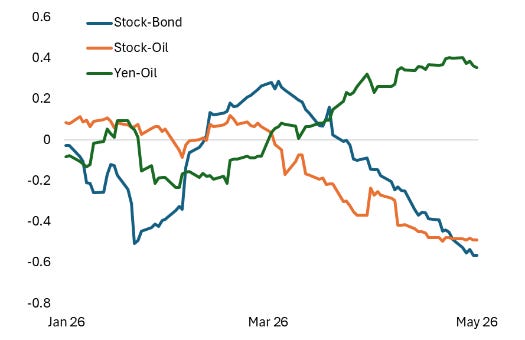
If the correlation between the Yen and Oil flips back to negative, oil prices may fall, which would drive Treasury yields lower and lift US cyclical equities over Tech.
Figure 2: Correlations between Yen, Stocks, and Oil
Source: NYSE, CME
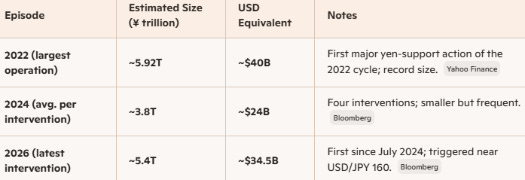
The intervention was unilateral, consistent with Japan’s long‑standing practice. The ¥5.4T operation is near the top end of Japan’s historical range and signals a high‑conviction defense line around USD/JPY ~160. For context, the average intervention size in 2024 was ~¥3.8 trillion (≈$24 billion) per operation.
Japan tends to intervene in large, discrete bursts, often followed by a smaller “reinforcement” operation if markets test the line again. Given the US Administration’s willingness to endure global macroeconomic pain to maintain the US naval blockade, the Yen may briefly retest 160 before a larger intervention (potentially bilateral with the US Treasury).
Table 1: Recent Yen interventions (Yen, trillion)
Source: Claude, FedWatch LLM, Bank of Japan