

Bed of Nitroglycerin

With a deal now very likely to be inked by Friday, markets are repricing equities of countries that (over)rely on crude oil and commodity flows from the Strait of Hormuz.
The countries that rely on nearly everything from Hormuz rallied the most, and in some cases (e.g., Japan), set new record highs: Japan, Korea, India, and a handful of smaller Asian economies rallied by 3 to 5 percent.
This is a clear sign that the significant easing of the war premium in oil will boost Asian economies in particular. It is also the part of the world where most of the monetary policy tightening was priced in, on average, 100 basis points, compared to 25 to 50 basis points in the US and Europe.
Thus, global financial conditions are set to loosen as the declining oil war premium removes most of the global monetary policy tightening cycle. With energy prices peaking in late April and down 30 percent, the energy shock seen in CPI indices should moderate quickly into July-August.
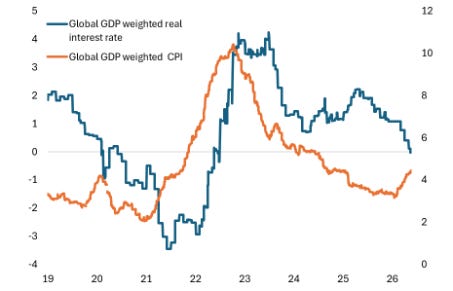
As the tightening cycle ‘flips’ to an easing cycle, real interest rates are poised to fall and turn negative even further.
It is a bed of nitroglycerin for high-beta stocks and SpaceX. With high-Hormuz-dependent countries like Korea, the Kospi is set to rocket, boosting parabolic trading in memory and semis.
While airlines and consumer discretionary stocks will enter a catch-up rally, energy could enter a short-term bear market as gasoline prices are set to fall sharply.
Figure 1: Global Real Interest Rate and CPI (%, Y/Y%)
Source: IMF, World Bank, Bank for International Settlements
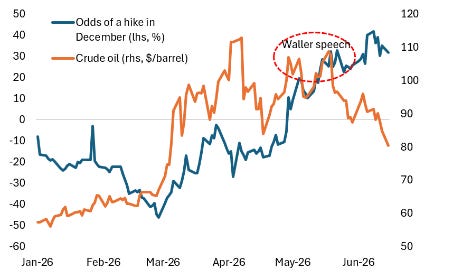
For the US, the odds of a rate hike may shrink quickly, especially given Waller, who initially sparked expectations of Fed tightening. In his speech on May 20th, which coincided with the third peak in oil prices, he made the case for staying put and watching how the conflict plays out.
Now an “end” to the war is truly nigh; however, inflation must improve for Waller to reconsider a rate cut. That said, a quick end to the conflict (which still took a month after his speech) could positively affect consumer expectations, as gasoline prices will fall, albeit slowly.
Figure 2: The Waller effect and Brent crude: now points to a rate cut (%)
Source: CME, ICE
Notably, gasoline demand has not tapered despite rising gas prices. The implied average demand for gallons per Station per week is 25,600, and that number has been stable since the start of the war. To meet that demand, U.S. stations collectively “buy” ~3.7–4.0 billion gallons of gasoline per week.
This volume must move through terminals, tanker trucks, and retail tanks.
Retail gasoline prices in the U.S. typically reflect crude oil price spikes within 7–14 days, with the fastest pass-through occurring in Gulf Coast-East Coast markets and the slowest in Rocky Mountain markets.
With Wholesale spot gasoline (NYMEX RBOB) reacting instantly to crude spikes, Rack prices at terminals adjust within hours.
Gas stations are buying new loads at falling rack prices, which are beginning to lower pump prices. Currently, the live national average price is $3.987/gal as of June 15, which is down 13.9¢ from last week and 53.4¢ from last month.
The forecast for gasoline prices, based on crack spreads, RBOB, refinery utilization, seasonal demand, and inventory, indicates a downward trend and a narrowing nationwide range from $3.92–$4.05/gallon next week to $3.88-$4.01/gallon the following week.
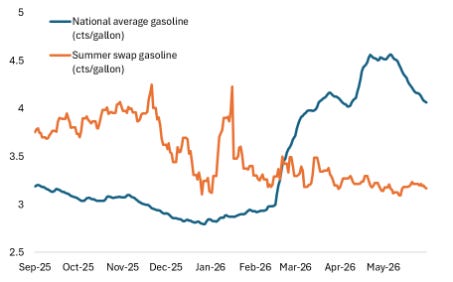
The “summer gasoline swap”—model‑derived estimate of the fair market value of the Summer strip (Apr–Oct) of NYMEX Henry Hub natural gas swaps--is trading at $3.20/gallon (see Figure 3).
This indicates that gas prices can return to pre-war levels, even to a year ago (when WTI was at $80 but gas prices were at $3.20), and that, too, is a bed of nitroglycerin for consumer spending and the economy into the fall.
Figure 3: Bed of nitroglycerin: gasoline and summer gas swaps
Source: Nymex, GasBuddy