

Calling All Precincts
Nvidia's latest financing is a sweet deal

Nvidia’s $500 billion compute‑financing alliance with six major Wall Street firms is the clearest signal yet that AI compute has become a capital‑intensive industrial commodity, subject to the same dynamics as energy inflation, capacity bottlenecks, and cost‑per‑unit scaling laws.
In macro terms, this deal addresses how to cope with “compute inflation”: the rising cost of producing incremental AI tokens and the rising costs of Gigawatts, driven by hardware scarcity, power constraints, and capital cycle acceleration.
This $500 billion financing consortium is essentially a capital markets wrapper around Nvidia’s supply chain, enabling customers to finance massive GPU deployments the way utilities finance power plants.
The capital will be raised by the consortium through their capital markets sale channels, meaning capital comes from institutional investors, RIAs, and family offices. Those must be convinced that the “yield” on compute from Nvidia is more attractive than its peers.
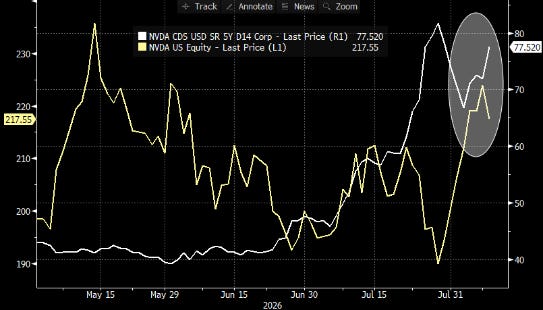
Markets viewed this as a possible hurdle; Nvidia stock traded down by 1 percent into the close, and spreads on its bonds widened by 5 basis points, including CDS (see Figure 1).
This reaction is in part because investors see Nvidia as a macro‑systemically important entity: the first hardware company to coordinate $500B in financing to set the industrial pace of AI.
Figure 1: Nvidia’s stock and CDS
Source: Markit, NYSE, Bloomberg
The catch is that this deal doesn’t eliminate compute scarcity—it financializes it. Nvidia is solving the capital bottleneck but not the physical bottlenecks (power, land, grid capacity, supply chain throughput). The financing accelerates demand for GPUs faster than the world can expand the infrastructure required to use them.
There are clear long-term macro implications, but investors will focus first on the near-term micro risks.
A maturity mismatch exists because Nvidia’s customers take on long‑duration debt for short‑duration AI hardware that depreciates in 18–36 months, while financing structures may run 7–10 years.
While this arrangement is neither debt nor equity financing from Nvidia, the following off‑balance‑sheet project‑finance structure involves banks and investors funding the data‑center buildouts. At the same time, Nvidia supplies the hardware, which creates transfer risks.
The financing structure pushes all the real risk onto the financiers and project sponsors. Each counterparty absorbs a different slice of exposure—credit, duration, obsolescence, liquidity, regulatory, and technology‑concentration risk—while Nvidia captures demand without taking balance‑sheet risk.
Banks absorb credit and duration risk as they lend long‑term against hardware that becomes obsolete in 18–36 months, exposing them to borrower cash‑flow shortfalls and concentrated exposure to Nvidia‑centric AI projects.
Private equity and infrastructure funds absorb obsolescence and Internal Rate of Return‑compression risk, as rapidly depreciating GPU clusters and dependence on Nvidia’s upgrade cadence could undermine return stability.
Money managers absorb liquidity and mark‑to‑market risk as thin secondary markets and portfolio concentration make AI‑infra debt highly sensitive to repricing and sponsor performance.
Nvidia smartly “called on all precincts,” as Apollo’s CEO said in today’s roundtable discussion, because this is a sweet deal.
The $500B financing may carry a steep 6–20% cost of capital—with senior debt trading at 6–9%, mezzanine at 10–14%, and equity at 15–20%+—because fast GPU depreciation and rising competition could push the project’s weighted average cost of capital into the 10–13% range (based on historical project financing estimates).
Nvidia, by contrast, earns far higher returns — ~75% gross margins, ~55% operating margins, 60–80% return on invested capital, and triple‑digit gains on new GPU generations — making its capital‑light, demand‑locked, upgrade‑driven model vastly more profitable than the yields the financiers and their clients may receive.