

Chuck Prince Goes Private

Last night, two events occurred within a few hours, which may spark a mid- to late-cycle credit crunch.
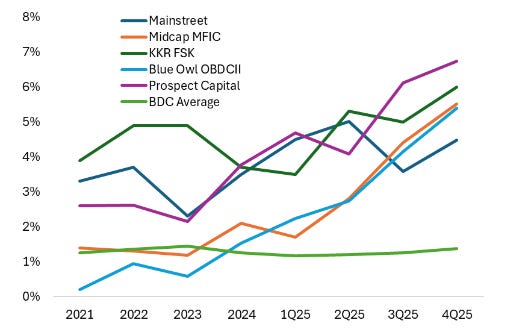
Midcap Financial Investment, a private credit fund co-managed by Apollo, cut its dividend due to a 3 percent portfolio write-down, citing an increase in non-accrual loans (loans that no longer pay interest). The exposure to software is 11.4%
KKR reported similar increases in non-accruals in one of its private credit funds (the FSK fund, which has 16.4% in software). Additionally, a UK lender, MFS, failed due to loan fraud and double-pledging, which entangled Apollo and several banks.
Earlier in the week, Blackstone’s lending fund reported impairments, and Blue Owl held a crisis-management conference call with financial advisors to assure them to stick with it, which drew skepticism.
These examples may show the moment when the music stops, even though private credit companies pay homage to Chuck Prince’s infamous reference.
While it may be too early to call for a larger boat, the deterioration in private credit is accelerating, and that is worth noting because this type of credit is often backed by sponsor companies that keep a tighter leash on borrowers than banks.
Figure 1: Private Credit non-accruals (%)
Source: 10-K/10-Q filings of Apollo, KKR, Blackstone, and Blue Owl.
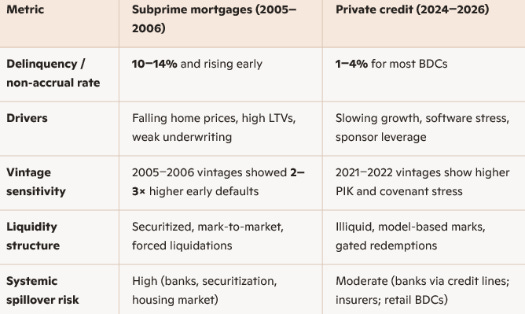
In 2005-2006, delinquencies on subprime mortgage loans had already surged to 12% and deteriorated more quickly than private credit non-accruals (see Table 1). Nonetheless, the parallel between subprime and private credit is “zip codes.”
Origination is different, but loans are tied to privately held companies (individuals for subprime) in a specific state or county. In other words, deteriorating private credit conditions could constrain credit to middle-market companies in local states, slowing the entire economy because banks are unwilling to step in.
As more non-accruals occur and retail investors become skeptical, leading to redemptions from private credit funds that do not (yet) experience stress, the non-accrual risk compounds, driving actual defaults, currently at 5.8% but projected to reach 15%, which are subprime-style delinquency levels.
Table 1
Source: Chicago Federal Reserve, Boston Federal Reserve
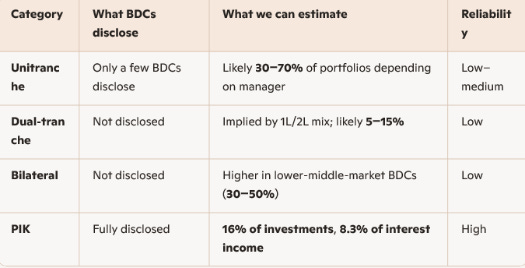
A complicated matter is payment-in-kind (“PIK”) and uni-, dual-, and bilateral-tranche loans issued in private credit (one- or two-lender packaged loans). In subprime lending, there were interest-only, balloon, and negative-amortization loans.
Compared to subprime, the flexibility of private payment loans is compounding interest, making non-accruals riskier to accelerate, reflecting a surge as seen in 2005-2006 ahead of potentially bigger problems. Across all BDCs, both public and non-traded, the different tranches and PIKs range from 15% to 70% of the total loans held in the sponsor companies’ portfolios (Table 2).
Table 2
Source: Pitchbook
There is potential for macro dislocation, just as subprime led to a significant rise in unemployment in 2008. BDCs have lent to 2,000–4,000 companies, which typically employ 100-5000 people, such that ~$1.5 trillion in private credit helped to create 1-2 million jobs, according to Fed estimates.
The BDC Reporter has been tracking “AI-related credit concerns” and notes that virtually every public BDC is now being asked about AI risk on earnings calls. Managers are discussing the potential revenue pressure on software and IT services borrowers, the risk that AI erodes business models (e.g., SaaS niches), and the possibility that AI could accelerate restructurings in already-weak credits.
The Fed may need to step in at some point with a new TALF (term loan) facility to absorb souring loans from Blue Owl, Apollo, and others, given the lack of liquidity and trading in private loans. No CDS contracts have been traded on BDCs yet, but that may change if the situation deteriorates.
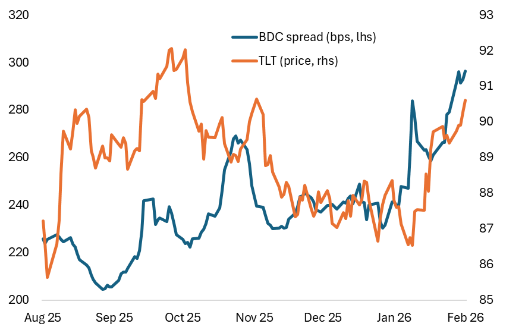
The Treasury market is celebrating this possibility given the causal link between BDC spreads and the long end of the yield curve (Figure 3). A sub-4 % 10Y yield is now signaling the potential for a more significant credit crunch ahead if more private cockroaches come to the surface.
Figure 3: BDC spreads (bps), and the TLT (20Y+ Treasury ETF)
Source: Markitt, iShares