

Citadel v. Citrini

It was only a matter of time before someone would come out to critique Citrini’s research blog post, which had such a profound effect on markets.
Frank Flight, an analyst at Citadel, makes a compelling case for why we should not worry about AI, since it would require massive adoption and unconstrained computing to achieve a near-total labor substitution.
What is notable is how each note affects markets. On Monday, the selloff was sharp and across the board in response to Citrini, which is an unknown research firm. Today, the rally is firm partly in response to Citadel’s post, a well-known hedge fund and securities firm.
Irrespective of the firm’s reputation, the notes going viral have a psychological effect on those who fear and those who dismiss AI’s massive worker displacement, with the shock being permanent, crippling the white color macroeconomy.
I asked the LLM to compare the two blog posts, and the verdict reads like a Supreme Court case. But the agent makes a strong conclusion in favor of Frank Flight’s analysis at a 60 to 65% chance, for an outcome of a benign productivity shock without a systemic collapse in the next 5-10 years.
If markets begin to embrace this outcome as the base case, the negative sentiment around software could reverse, leading to bargain hunting in beaten-up software and tech names (and financials).
Table 1: Citadel v. Citrini
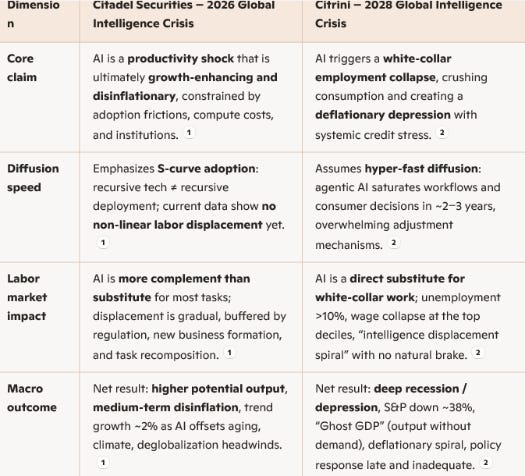
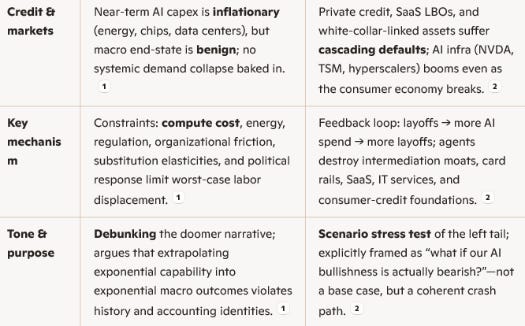
*Citadel‑style outcome (benign productivity shock, no systemic collapse): ~60–65%
Source: Gemini, FedWatch LLM, Citadel, Citrini Research
History is on Citadel’s side: tech shocks have been disruptive but ultimately absorbed. Current data on AI adoption and labor markets still suggest an evolutionary, not catastrophic, trajectory.
There is (of course) a hybrid outcome possible too, which is a meaningful disruption with sectoral recessions but not a full Citrini doom loop. The LLM models estimate this scenario to be ~25–30%.
Finally, it is plausible that white‑collar compression, private‑credit marks, and intermediation erosion create localized crises (SaaS, IT services, some consumer credit) without a 10%+ unemployment depression.
As such, Citrini‑style left‑tail (10%+ unemployment, “Ghost GDP,” systemic demand collapse) has around ~5–10% according to the LLM, a low but not entirely insignificant number.
This is coherent if you assume there is a very high substitution elasticity between capital and labor, and a very slow fiscal/regulatory response in Congress to pass AI labor protection bills.
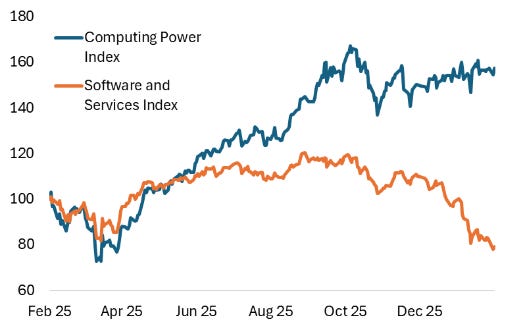
Software is totally disconnected, but as computing power trends indicate, AI needs infinite capacity to take total control. As the state of the union emphasized, tech companies are responsible for generating the power to support such capacity, which constrains AI’s potential for full domination.
Figure 1: Software vs. Compute Power Index (normalized scale)
Source: S&P, BITA
-