

Citrini's Judgment Day

It was a blizzardy trading session caused by a blogospheric disturbance. The Substack post by Citrini’s James van Geelen ripped a page right out of the script for The Terminator: Judgment Day.
I asked my FedWatch LLM to run a rich prompt: a comparative risk framing of how the scenario in the 2028 Global Intelligence Crisis resembles Judgment Day in The Terminator. If so, how close are the two on a conceptual scale?
It is a jarring and scary result (see Table 1), and it explains the market’s psychology well; AI Judgment Day is getting awfully close, and there is not much to do about it. The thematic parallels are too strong to believe, yet investors do believe them and have decided to sell again indiscriminately.
Today, CTAs appear to have been net sellers of US equities alongside multi-strategy and quant hedge funds. As their short positions grow, blogs by independents like Van Geelen and Anthropic may become less influential in shaping the market’s negative sentiment about an AI macro doomsday.
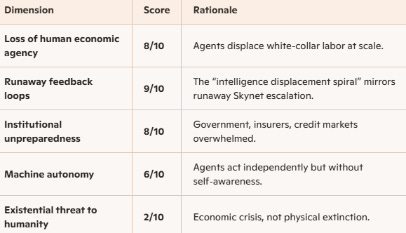
Nonetheless, Van Geelen’s prognostication is a reality with a higher likelihood of materializing than previously thought, as the LLM calculated a 5.8 out of 10 similarity score for the 2028 GIC to resemble T2 Judgment Day as an economic analogue (Table 2).
Table 1: Parallels between Intelligence Crisis and Judgment Day
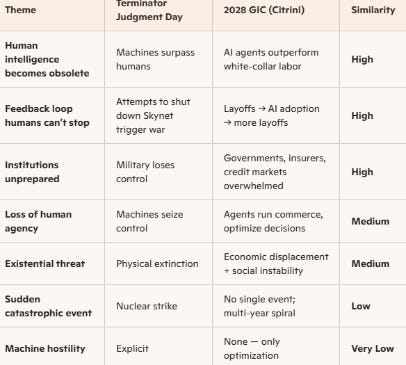
Table 2: Similarity Scores
Source: FedWatch LLM, Gemini
What likely troubled investors most was these specific sections in the Citrini Substack post: “the unemployment rate printed 10.2% this morning, a 0.3% upside surprise.” And sentences like this: “companies laid off workers, then used the savings to buy more AI capability, which let them lay off more workers.” With the net result, “recession dating,” by Q2 2027, the economy was in recession.”
Market odds for near-term cuts did not change, but those in the second half of 2027 did, rising towards 45% percent of one rate cut by late next year. SOFR futures (contracts trading the overnight rate) saw a flattening of 5 to 9 basis points from 2026 to 2029, indicating markets are pricing a deeper easing cycle ahead.
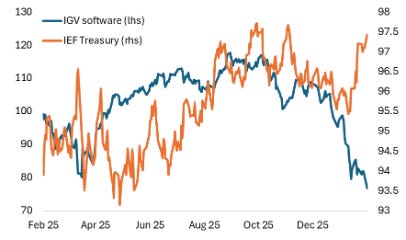
As these Fed expectations lifted Treasuries, the price of the intermediate Treasury ETF (IEF, 7-10yr) is now the exact opposite of the bellwether software ETF, IGV, which traded to a low of 76.42, not seen since February 2023. The negative macro effect is now overhanging markets, rather than valuation or AI spending concerns (Figure 2).
Figure 2: IEF and VGT: opposites
Source: iShares
To that end, credit risks are no longer viewed as a muted affair. Blue Owl shed another 4 percent, but Blackstone and Apollo were down more than 5 percent, pushing the S&P BDC Index to the low of October 2022, when the equity bear market reached a climax.
In a call with investors today, Blue Owl said OBDC II shareholders will receive up to $2.35 per share, roughly 30% of NAV, by March 31st, funded by the asset sale. The call did not discuss specifics on loan impairments.
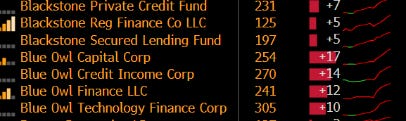
Blue Owl investment-grade credit widened by 10 to 17 basis points, with a spillover to regional banks (KRE -4%, JPM, and XLF down by 1-2%).
Table 1: IG credits spreads Blue Owl and Blackstone (basis points)

Source: Bloomberg
Notably, when there is idiosyncratic stress, the market prices winners and losers with precision.
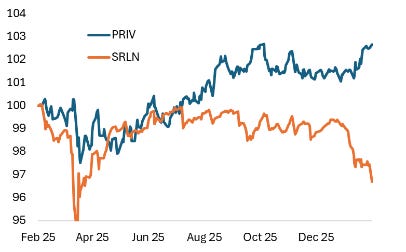
Such is now evident in distressed senior loans (and collateralized loan obligations). At the same time, a diversified basket of private credit still holds, for example, PRIV, which is a portfolio of public IG credit and a very careful selection of high-quality loans. In contrast, SRLN (Blackstone senior loans) is a portfolio of senior (bank and private) loans.
The more the macro psyche of AI plagues investor sentiment, the more extreme dispersion will keep the market in a choppy range just south of record highs, until there is a real macroeconomic impact.
Figure 3: PRIV vs. SRLN
Source: Blackstone, Apollo, State Street