

Clock Tower Strikes 8 PM

With every new threat to escalate the conflict, the market’s reaction is getting milder. Yields are up by half from previous escalatory episodes; the same goes for Brent, which is up by a marginal $1, while Gold is gaining, and equities are mixed.
Even though 50 military targets were struck at the Kharg Island, the energy infrastructure was untouched. With more than 15 ships passing through the Strait of Hormuz and no maritime attacks by the Houthis reported in the Bab el‑Mandeb Strait during the last 24 hours, markets will continue to trade the flow of oil (transit) rather than the stock (output).
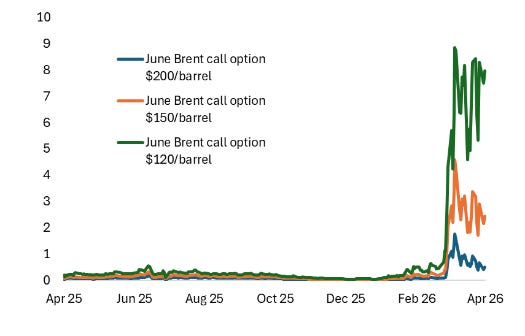
Unless a ground invasion takes place on the Kharg Island to seize energy infrastructure, or the Bab Strait is materially disrupted, the oil options market is seeing limited upside; $120/barrel is still trading at a hefty premium, options see much lower odds for $150-$200 oil, and those premiums are falling (see Figure 1).
Figure 1: Oil tail risks ($, premium)
Source: Intercontinental Exchange
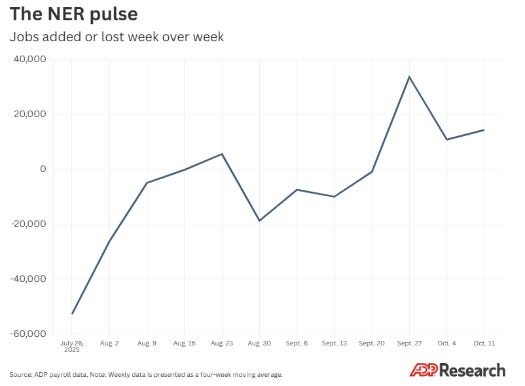
To the markets, the clock tower may already have struck 8 pm, despite the President’s latest ominous headlines. Economic data, such as a much stronger-than-expected ADP report (26K), get attention, given the cumulative improvement since the fall (see Figure 2).
Figure 2: ADP; cumulative improvement (weekly data)
Source: ADP research
NY Fed Williams views numbers like ADP as the reason for the stability of unemployment, while fading tariff inflation should bring underlying trend inflation down ‘later this year.’ Notwithstanding Williams’ expectation that inflation will rise above 3 percent due to the energy shock, which can filter through to a moderate rise in core inflation.
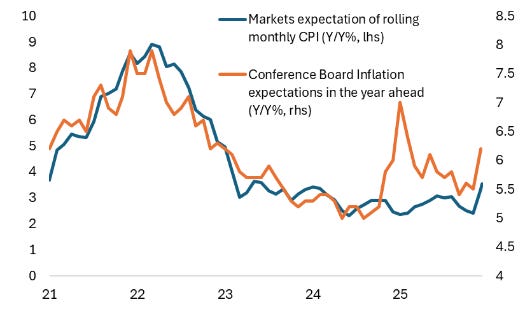
Inflation expectations are driving the outlook for inflation; the market is pricing in 3.75% headline CPI, as Williams noted. On Friday, the first inflationary shock will be visible, with a m/m change potentially at 1.3%, and a range of products affected by disruptions to fertilizer, helium, and aluminum.
Figure 3: CPI expectations (Y/Y%)
Source: DTCC, Conference Board
To that effect, it is also Deadline Day for fertilizer. Across the Northern Hemisphere, early April marks the moment when corn, wheat, and many spring crops require nitrogen application before seeds go into the ground. Farmers typically apply urea or 28% nitrogen solutions right now to set yield potential.
This is why the timing of “fertilizer day” is non‑negotiable: nutrients applied after planting often cannot rescue yield potential. The closure of the Strait of Hormuz has bottled up 50% of global urea exports and cut off natural gas and sulfur flows—critical inputs for nitrogen and phosphate fertilizers.
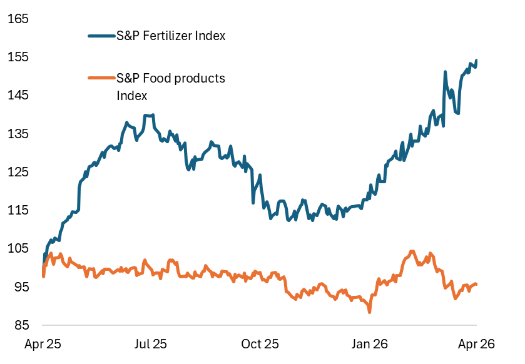
In addition, forced fertilizer plants in South Asia to shut down and pushed China to restrict exports. The Strait chokepoint disruption is hitting at peak seasonal demand. This issue is not playing in broader markets, except for the S&P fertilizer index compared to food products indices (see Figure 4).
While 8 pm is a hard deadline (though Trump did indicate moving the goalposts if there is progress on a deal), the change in CPI, especially in food, could trigger an “affordability crash.””
Figure 4: S&P fertilizer and food products (normalized scale)
Source: NYSE
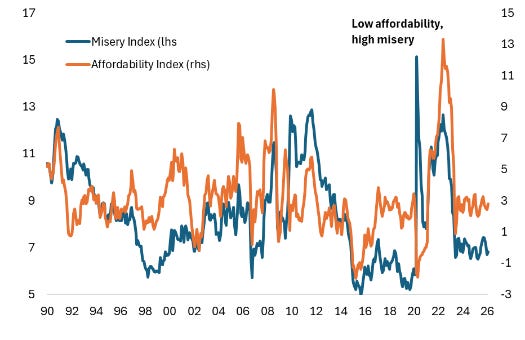
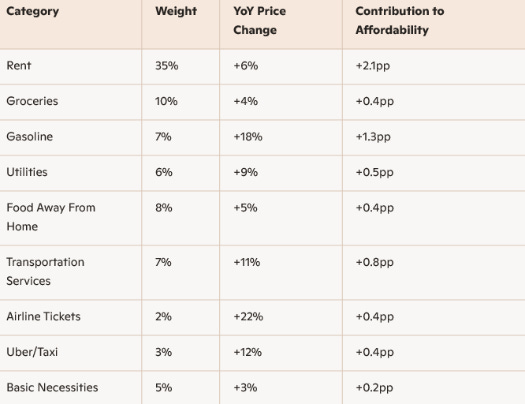
I constructed an affordability index based on relevant BLS categories of daily necessities, food, energy, and other purchases (see Table 1). Since the 1990s, the affordability index and the “misery index,” which is the sum of the unemployment rate and CPI (old 70s measure), have had a close relationship.
Right now, affordability and misery are in a decent place, but that is already dramatically changing given the nature of the energy shock (Figure 5). Most affordability index components are already up 5% to 22% year over year (see Table 1). The Friday CPI release is when the clock tower really strikes 8 pm, as it can significantly change the Fed’s and the market’s narrative.
Figure 5: Affordability and Misery Index
Source: BLS, FedWatch LLM
Table 1: Affordability Index weights (%)
Source: FedWatch LLM