

Do the Right Thing

A discrepancy in expectations is developing. The swing in the odds of a cut at 86% contrasts with “10 of all 19 members signaled in speeches or public interviews that they didn’t see a strong case to cut,” according to the count by the WSJ.
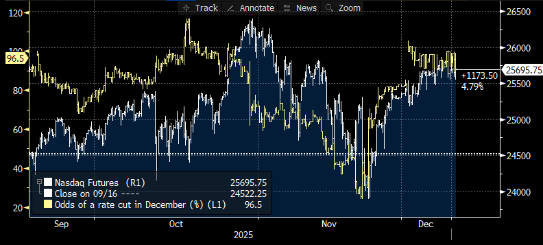
It has created a reverse head-and-shoulders pattern in the Nasdaq and S&P (over the last 60 days, intraday data) that mimics the reversal in rate-cut odds. The market is now completely fixated on the rate decision, which is staying at 95% at the latest real-time read (Figure 1).
But the contrasting signals from the economy continue. JOLTS for October showed decent strength, with layoffs and quit rates both falling; the ADP 4-weekly average was positive at 4.75K, and the NFIB hiring plans index jumped by 4 points.
This is an overall improvement of labor conditions, which makes the case for risk-management rate cuts less compelling. For markets, that is a good sign because it suggests past rate cuts are helping stabilize employment. S&P and Nasdaq are at the cusp of breaking out again.
Figure 1: Nasdaq and Odds of a rate cut (%)
Source: CME
Kevin Hassett, speaking at the WSJ CEO Council, is questioning how low rates could go. His noteworthy remark to the question of “What would you do if Trump wanted you to cut rates and you didn’t think it was the right thing to do? KH: “If inflation has gone from 2.5% to 4%, you can’t cut rates then…”
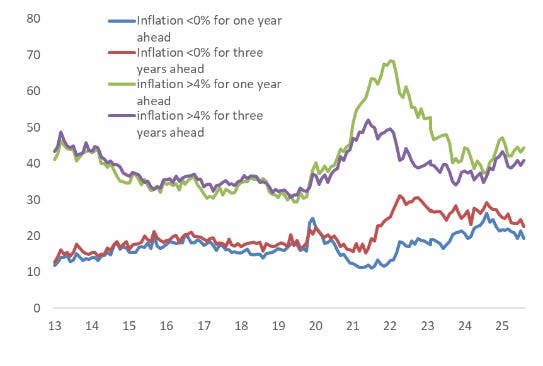
It poses a future dilemma, especially from a consumer expectations perspective. In yesterday’s NY Fed consumer expectations survey, there was a breakdown of inflation expectations: prices rising by> 4% and prices falling by <0%.
There is a notable divergence here as well: consumers expect prices to increase by more than 4 percent over the next 1 to 3 years, while fewer expect prices to decrease (Figure 2).
Persistent high inflation expectations lead to realized inflation, and the pattern has become very persistent since 2022. While Hassett banks on the 1990s effect of technology on prices, which indeed brought core PCE to and below 2 percent between 1996 and 1999, Treasury yields reached over 6 percent.
Figure 2: Inflation expectations: > 4% and <0% in the next 1-3 years
Source: NY Fed
For Hassett, there will be an immediate challenge at the June 2026 FOMC. As the president set the bar of a litmus test, the markets expect a 50/50 chance of a cut. He said that if there is pressure on the Fed to cut, “just do the right thing.”
But Hassett himself seems to be changing his tone. In several interviews with financial media outlets, he said the Fed should proceed cautiously and prudently, with an eye on the data, and acknowledged that inflation expectations are too high.
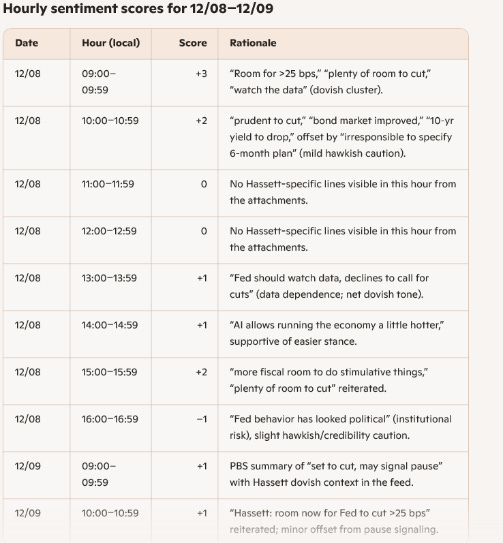
By running the large language model on his headlines over the last 24-48 hours, the output shows his tone was mixed, leaning net-dovish (see Table 1).
The effect on yields and equities remains positive so far: yields are up on improving data, and equities discount the risk that rate cuts are beginning to work. Yields could reach 4.25% and the S&P move towards 6900.
Table 1: LLM Output of Hassett’s comments about the Fed over the last 24-48 hours
Source: FedWatch, OpenAI
Dovish (+1): “plenty of room to cut,” “room for >25 bps,” “prudent to cut,” “watch the data,” “stimulative fiscal room,” “10-year yield to drop,” “AI allows running hotter,” “Powell done a good job,” “rate tweak should follow data.”
Hawkish (–1): “Fed behavior has looked political,” “hawkish rate cut,” “independence risk,” “Trump pressures Fed,” “would be irresponsible to lay out 6‑month rate plan,” “credibility/politicization concerns.”