

Economic Reacceleration

The retail sales showed something promising. It appears the summer swoon in the economy is dissipating. Since early July, regional surveys have begun to turn, starting with Dallas services, Empire, and Philly Business Outlook, which have reversed from negative to positive, driven by new orders and shipments, following the import front-loading.
The underlying strength in the economy is evident in the GDP headline, with the retail control group annualized growth rate at 4.7 percent nominally, including net-trade and small business surveys, which have seen an uptick. Underneath, however, is a weakness nestling in the labor market that is losing momentum, caused by a myriad of reasons.
The strengths and weaknesses combined in a composite show the economy and labor market are at a similar juncture as last summer; the economy is reaccelerating while labor dynamism fades (Figure 1).
It is the perfect combination for the Fed to apply “insurance rate cuts,” which in turn reverses the labor weakness, ripening conditions for the inevitable technical correction in stocks become (once again) an opportunity.
Figure 1: Weaknesses/Strengths Labor versus Economy
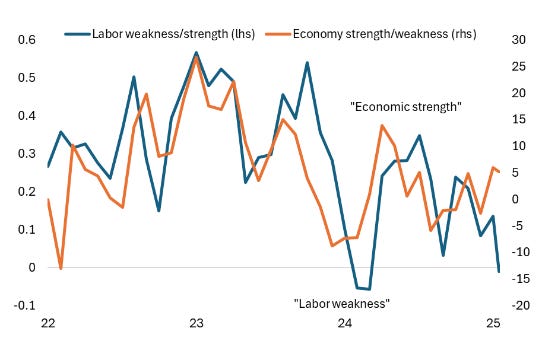
Source: BEA, Retail Federation, Kansas Federal Reserve, Bloomberg Economics –Labor composite: labor momentum index, labor surprise index, and Jolts hires. Economic composite: GDPNow, economic surprise index, retail sales control group nowcast
Yet, the labor market is deteriorating, which is an issue the Fed wants to get ahead of, especially to avert a stagflation outcome. For example, the Atlanta Fed labor spider web shows that of the 15 labor indicators, over 50 percent are in distress territory as experienced in 2020.
Notably, “labor flows,” which measure time to get hired, ability to find work, duration of unemployment, and weekly and continuing claims, are worsening sequentially. Contrary to the pickup in activity in manufacturing and retail, firms' plans and intentions to hire are at a 5-year low (albeit the latest NFIB showed a modest uptick in hiring plans index).
Sentiment about labor prospects is as important as the labor market itself. It measures health from a willingness to work standpoint, which is key in sustaining labor force growth and productivity. The New York Fed’s probability of finding work within 3 months of losing a job dipped to 50 percent, while the BLS “labor flows,” –total unemployment to employment continue to go higher (Figure 2).
These trends are pointing to the risk of the unemployment rate suddenly spiking, which then could strike the fear of stagflation right in the heart after the hotter, stickier inflation reports from last week.
For the Fed, this risk of stagflation caused by a runaway unemployment rate affected by structural weakness, as seen from rising insured unemployment and permanent layoff ratios (see Figure 3), must be arrested.
Figure 2: Labor flows and expectations of finding a new job quickly (%)
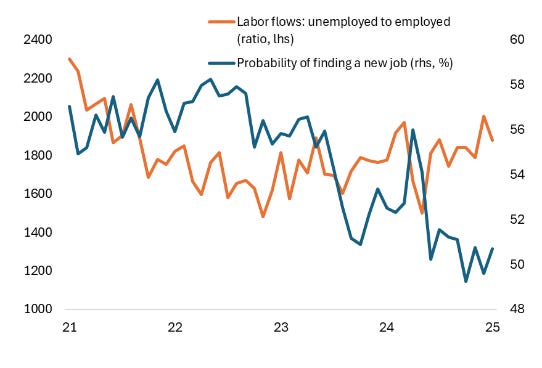
Source: BLS, New York Federal Reserve
Figure 3: Structural labor weakness
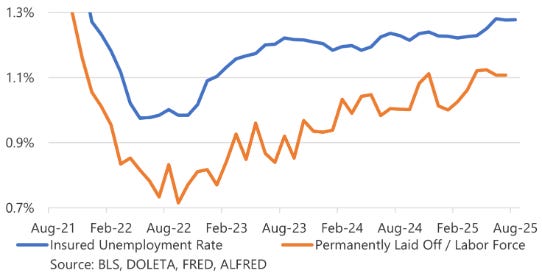
Source: Guy Berger Substack
This week, the economy received first-hand evidence that the summer slowdown is fully reversing, as indicated by the S&P services and manufacturing PMI surveys on Thursday, which previewed the ISM data to be released early in September.
Housing data could see a mild rebound on lower yields in July-August, while retail earnings highlight the evidence of tariff pass-through at the retail consumer level.
The FOMC Minutes will be relevant in the context of the debate of persistence of inflation versus labor weakness, which the dissenters weigh more, and Powell may have struck a balance in his JH speech, dashing hopes for larger cuts, which may then undermine short-term bullish sentiments that look stretched.
The AAII bull-bear spread has narrowed, and the Z-score (based on a 25-year history) is in negative territory like in 2022. The S&P 14-day Relative Strength Index, a short-term momentum gauge, remains nearly overbought at 70 (Figure 4).
The divergence between sentiment and overbought has not been this wide since 2021, making a short-term correction on dashed rate cut hopes all but inevitable, against the long-term of economic reacceleration, which makes such a correction equally attractive.
Figure 4: AAII Bull-Bear and S&P RSI
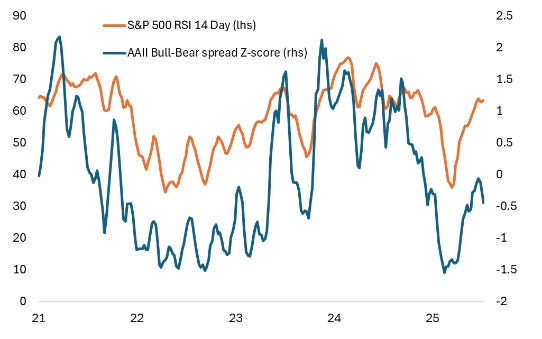
Source: AAII, NYSE