

Economy's Flight Path

During the pandemic shutdown, when visibility into the economy dropped to zero, indicators such as the number of travelers passing through TSA checkpoints were closely monitored. This metric has been declining lately and has accelerated its downward momentum since the shutdown began.
Now that the government debacle is prolonged, the next airspace metric comes into focus: the number of domestic flights, which will be cut by 10% starting tomorrow.
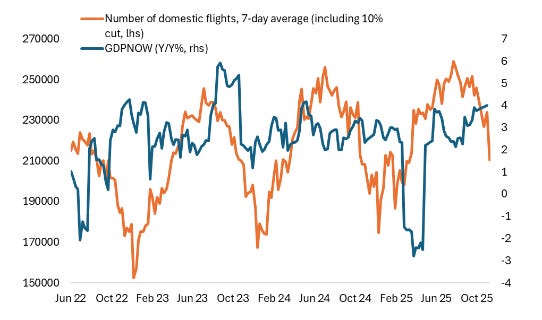
Domestic flights serve as a real-time economic momentum indicator, exhibiting several characteristics of leading indicators. When the number of domestic flights declines, GDPNOW is expected to lose between 0.1% and 0.5% in the next 1-2 weeks and may slow even further, as observed in the past (Figure 1).
In the very near term, it may matter to markets, as the self-inflicted cuts in flights could slow down the private sector economy, which has been running on most cylinders.
Figure 1: GDPNOW (Y/Y, %) and domestic flights (000s)
Source: TSA, Atlanta Fed
GDP components directly related to transportation, domestic air traffic, and logistics are primarily captured under the categories of “Private Fixed Investment: Nonresidential Structures” and “Real Gross Private Domestic Investment: Equipment.”
These categories reflect capital spending on infrastructure, vehicles, and logistics systems that support domestic air traffic and broader transportation networks. As GDP appears to be more investment-driven this year, in part because economists estimate that data centers have contributed up to 2.3% to economic growth, a reduction in air tariffs and logistics costs could cool off the investment contribution.
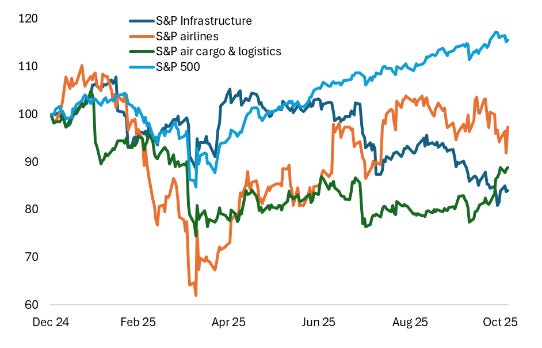
Within the S&P 500, sectors related to flights have lagged the broad index by 30 percent since Liberation Day, indicating that the disruption to the transportation sector of the economy has been ongoing for some time. The broader market may not be as affected as the weightings of these sectors (and related companies) are less than half a percent.
Nonetheless, the economy is poised to slow in the next week(s), as tentatively reflected in the Fed’s weekly activity indices; the Dallas Fed weekly economy index is down by 20 percent since mid-October, and the Chicago Fed bi-weekly saw a tiny tick up in the unemployment rate to 4.36% (from 4.35% last month).
Figure 2: Lagging sectors related to air traffic
Source: NYSE
To Goolsbee, it remains a case of caution because there is mild trepidation in labor, but at least there is some visibility in the data fog. However, inflation is not present, and the recent BLS report showed too much non-tariff-related service inflation. So, he too remains cautiously hawkish, without a hawkish view on rates in the longer term.
If the Supreme Court were to strike down reciprocal tariffs, which could lower the average effective tariff rate (based on tariffs/imports) to 10%, a rate already falling to 13% due to recent trade deals made in Asia, according to Fitch.
However, that could provide the economy with relief, especially when the government reopens. After all, the core goods CPI has contributed 0.35% to inflation, and since tariffs came into effect, it has emerged from a period of deflation.
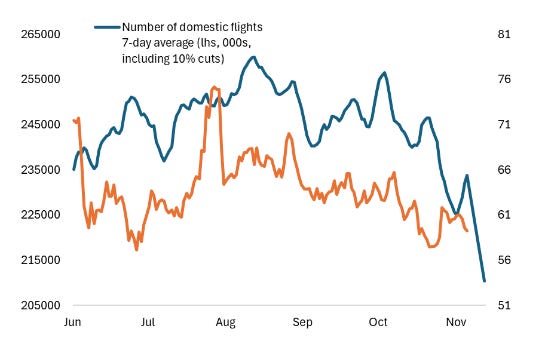
The economy’s flight path could be temporarily down in the next week(s), even though private sector surveys indicate improvement in employment orders, while tariff uncertainty continues to loom. Yet, the potentially biggest loser is WTI, which is most sensitive to flight reductions, suggesting oil prices in the 50s.
Figure 3: Number of flights (including announced reduction) and WTI (orange line)
Source; FAA, CME