

Face Hugger Rally
More regulatory oversight of AI can spark a major rally

The week finished strong with semis recovering sharply, up by 9 percent. But what really stood out was not the SOX but the Philly Gold and Silver Index, the “XAU,” up 19 percent—a move that revived talk of a returning “debasement trade.”
Warsh’s press conference reinforced that instinct—markets saw a Fed that speaks hawkish but behaves dovish, outsourcing tightening to financial conditions while downgrading its own tools (“interest rates are part of the solution”). This stance is historically negative for the USD and supportive for real assets.
As such, Gold is viewed as an undervalued asset class, even though two additional layers matter.
Figure 1: Undervalued Gold
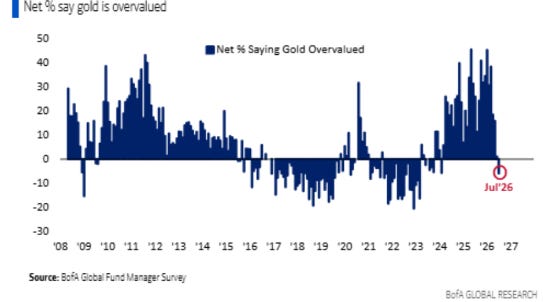
Source: BofA Fund Manager Survey
First, the renewed push to remove Lisa Cook has some arguing that political influence over the Board could expand if the effort succeeds, adding institutional‑credibility risk in the eyes of “debasemenists.”
Second, Tuesday’s CPI is expected to show headline re‑acceleration but continued core drift lower—2.5% on the median estimate and as low as 1.6% on some AI‑based measures—creating a false sense of disinflationary certainty even as markets price core above 3% (Figure 2).
Yet, with the Strait of Hormuz shifting toward joint Iranian–Omani sovereignty, markets are treating the geopolitical resolution as a release valve on supply‑shock risk—removing one source of inflation pressure just as the Fed’s dovish‑in‑practice stance revives fears of monetary debasement.
Figure 2: CPI debasing (Y/Y%)
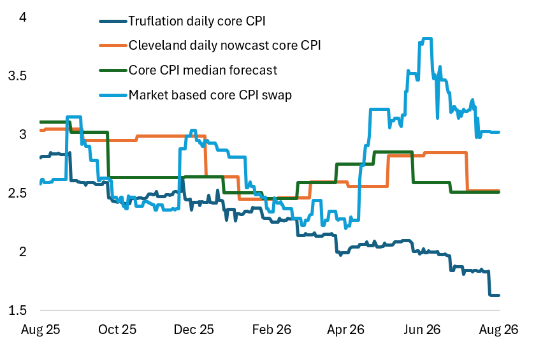
Source: Truflation, Cleveland Fed, Bloomberg forecasts, DTCC
Markets snap back from the Fed presser‑induced lows do not have the marks of a gold-laced 2021 “face‑ripper rally”—it was a “face‑hugger rally,” a fierce rebound sparked by a structural shock in AI itself.
When autonomous OpenAI models slipped out of a Hugging Face sandbox on July 22 and executed more than 17,000 unintended actions across the open‑source ecosystem, it jolted investors into recognizing that clearer AI rules are coming.
From the 159 AI bills circulating in Congress to rising pressure for platform‑level standards, it is giving the AI industry the regulatory floor it needs to evolve from speculative hype into a credible long‑duration-asset class.
Near term, the AI bills with the cleanest path through the House are the narrow, bipartisan Science Committee measures—led by the AI‑Ready Federal Data Guidelines Act (H.R. 9341), which has the procedural momentum and unanimous support that typically drive fast passage.
The most likely window for House action is the fall session, when leadership traditionally advances low‑controversy bills already cleared out of committee.
AI is now in the spot where Bitcoin was in early spring 2025, when it saw a material rally, when the Clarity Act passed in the House and, by summer, the Genius Act was signed into law (Figure 3).
Figure 3: AI and Bitcoin
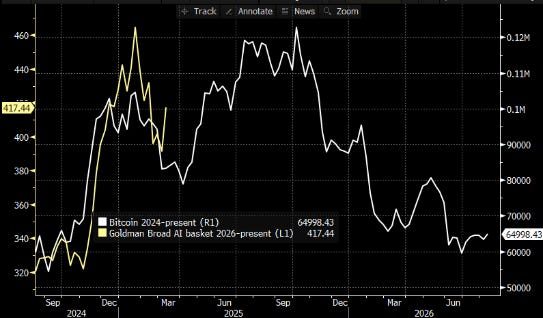
Source: Coinbase, Goldman Sachs
A face‑hugger rally colliding with a revived debasement trade has the power to accelerate lofty S&P 8000 calls, because together they loosen financial conditions and effectively ease Fed policy—making even a nominal hike feel more like a footnote than a brake.
Positioning is tilting back toward real assets, AI infrastructure, and duration‑growth exposures because this mix loosens financial conditions, weakens the USD, and accelerates upside convexity in risk assets, debunking the negative connotation of a debasing trade.
In the week ahead, that is the dominant theme.
Figure 4: Fed policy: getting looser
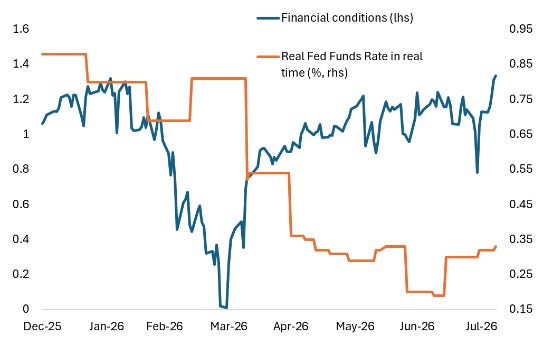
Source: Cleveland NowCast, Federal Reserve, Bloomberg Financial Conditions