

FIMA Kabuki
Repo and swap lines are not infinite

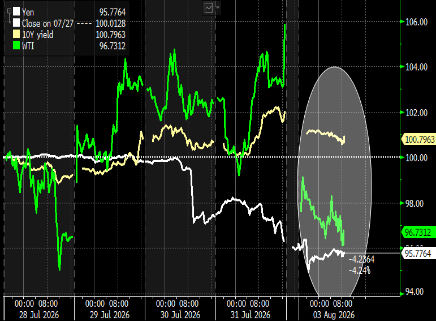
Cutting through the ‘noise,’ an intra-day (noisy) picture (Figure 1) tells the markets’ story. The Yen is not having as much impact as oil has on the 10Y yield. A bigger macro picture is at work.
Treasury yields rose sharply after Wednesday’s Fed press conference because investors balked at a lack of details of how Warsh would go about getting inflation down. But yields also rose because that day oil prices were up by 8 percent as the President threatened the largest attacks on foreign soil (Iran) since WWII.
Yields reflect the direction in oil, which impacts inflation, and informs the Fed’s reaction function. As that function is uncertain, and the fluidity of the conflict causes upward pressure on oil prices, Treasury yields have become ‘unhinged.’
If the conflict changes, the effect on oil could be so material that it becomes an intervention in the Yen by itself as US rates fall.
Figure 1: Yen, Oil and 10Y yield (normalized since 7/28/26)
Source: Comex, FXAll, Tradeweb, Bloomberg
Several additional intervention methods were floated to avoid a “fire sale” of US Treasuries.
One is the Foreign and International Monetary Authorities (FIMA) Repo Facility. This permanent Federal Reserve liquidity tool lets foreign central banks raise short‑term U.S. dollars by pledging their U.S. Treasury holdings as collateral.
The facility functions as an above‑market‑priced backstop that prevents forced Treasury sales, eases global dollar funding stress, and protects U.S. financial stability; fully collateralized repos distinguish it from swap lines that require no Treasury collateral.
Japan’s Ministry of Finance confirmed that the coordinated U.S.–Japan intervention used the FIMA facility to obtain dollars without selling Treasuries, but the draw size remains undisclosed; with the facility capped at $60 billion and Japan’s intervention totaling $59 billion, Bessent is now pushing for the Fed to increase FIMA’s capacity.
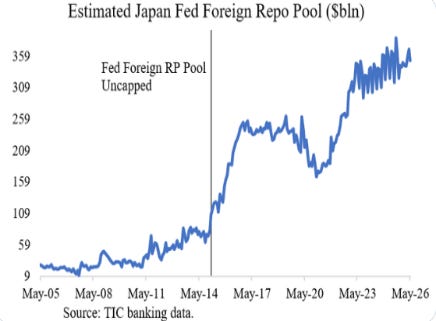
But the FIMA is a bit Kabuki, the Japanese word for theatre. According to some analysts, Japan already has $350 billion sitting in the Fed’s foreign repo pool (see Figure 2).
Japan has a dollar swap line with the Fed, and although it remains fully active, Japan hasn’t drawn on it recently; Fed data show only about $0.4 billion outstanding across all participants with no indication the BOJ is the borrower.
While FIMA and swap lines can expand the current FX war chest available—ESF and Fed currency reserves + BOJ currency reserves—they are not infinite instruments.
Figure 2: Japan foreign repo pool at the Fed ($, billion)
Source: Treasury TIC data
What ultimately matters for the Yen, the carry trade and therefore markets, is how the BOJ approaches monetary policy from here.
The BOJ remains in quantitative and qualitative monetary easing, QQE, not QT: it is still purchasing roughly ¥6–7 trillion of JGBs per month, its balance sheet stands near ¥780 trillion (about $5.0 trillion), and at roughly 120–125% of GDP it remains one of the largest central‑bank balance sheets in the world, with no sustained reduction underway.
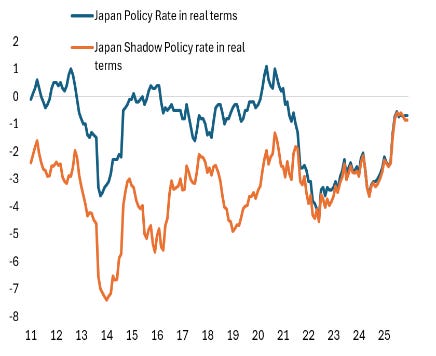
As a result, Japan’s “shadow policy rate,” measured by the size of the balance sheet, and its current policy rate are below inflation (see Figure 3). These reflect that monetary conditions in Japan remain very loose, which is a significant weakening force behind the Yen.
BOJ Governor Ueda has signaled further tightening by pointing to three rate hikes through 2026-27, stronger wage gains, and durable 2%‑plus inflation as evidence that Japan is steadily moving away from large‑scale easing toward policy normalization.
Given this slow, incremental path, the yen cannot strengthen on its own, forcing ineffective interventions that invite renewed short‑yen positioning, fuel carry trades, and keep pressure on Treasury yields upward while boosting leveraged risk assets once intervention fades.
Figure 3: Japan’s problem: negative real interest rates (%)
Source: Japan MoF, RBNZ