


European sovereign spreads are widening in lockstep, bank stocks are sliding, and the interventionists are resurfacing just as they did a decade ago.
Lorenzo Bini Smaghi — a member of the ECB Executive Board during the 2011 crisis and one of its most outspoken defenders of intervention to preserve monetary transmission — is back in the debate, with a new FT piece making the very same case today.
The ECB has so far been silent and instead is laser-focused on containing inflation, with overnight comments from its chief economist, Lane, arguing Europe is at risk of a second wave of energy shock.
Lagarde and Nagel acknowledged that French spreads may be widening, but the ECB’s tools only activate when monetary transmission breaks — not when a single country’s spreads blow out.
Intervention still lurks in the background — if French bonds and bank stocks slide into a true sovereign crisis, the ECB could justify stepping in under fiscal‑discipline conditions and finally activate tools like the never‑used TPI, a mechanism aimed not squarely at spread stress.
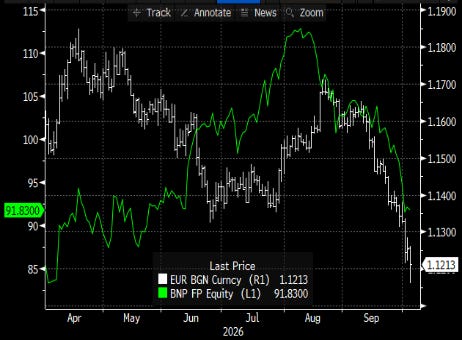
As a result, the Euro and French banks caught a tailspin (see Figure 1) amid swirling speculation of “Frexit,” as French CDS and spreads blew out to an average of over 100 basis points.
Figure 1: French banks and the Euro
Source: CAC40, Eurex
Because TPI only activates when spreads are clearly unjustified and monetary transmission is at risk, the tool is inherently a late-cycle mechanism. The country is fully compliant with EU fiscal rules, free of major macro‑imbalances, fiscally sustainable, and running sound policies.
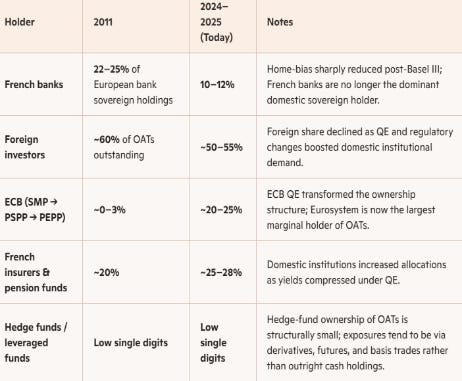
While French debt holdings have materially shifted from banks to the ECB since 2011, enough remains for financial stress and contagion in the French system to spread, especially if the policy impasse over activating intervention tools persists.
Table 1: Holdings of French bonds by entity in 2011 versus today (% share of total)
Source: SEC, Banque de France, ECB, Eurostat
The spillover into U.S. banks is clear: as French spreads widened in early August, KRE slid 8%, sharply lagging the S&P, while French bank spreads widened 110 bps and U.S. regional banks followed with a 25 bp widening. Regional banks still sit on substantial unrealized losses that are growing again (see Figure 3 below).
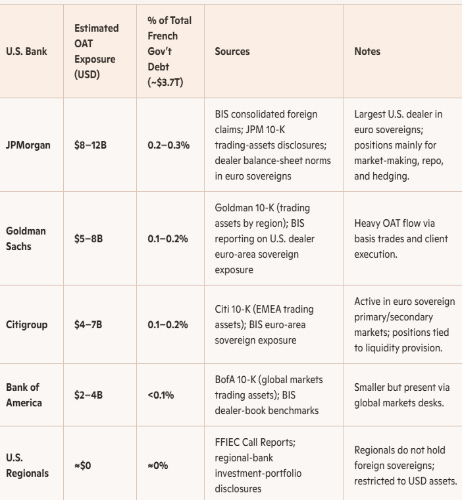
US investment banks, however, widened by less (~10-15 bps on average). While their exposure to French OATs is marginal (~0.2%), they participate through speculative trades (basis), hedging, and market making (see Table 1).
Still, a 0.2% exposure to French bonds is a transmission channel to major US banks if speculation around ‘Frexit’ picks up.
Table 2: US banks’ holdings of French banks (% of total share)
Source: BIS, 10-Ks, FIEEC
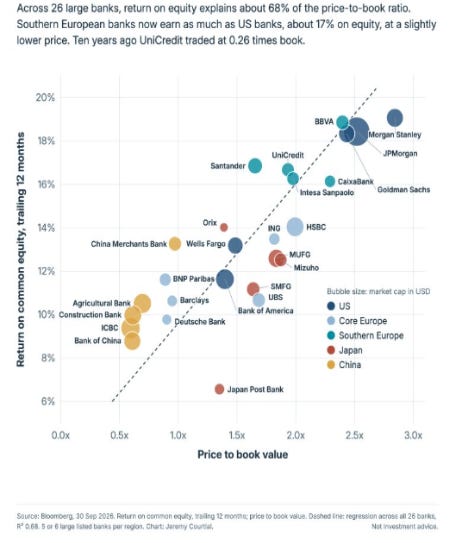
Unsurprisingly, bank valuations for France are low, but they match several major US banks (see Figure 2). That said, the valuations of US investment banks, even though with marginal French exposure, are substantially higher.
Sovereign contagion lives in several markets—Japan, France, and yes, even Treasuries—and always spills over. Ahead of bank earnings next week, the move in French spreads could shape how investors judge the results.
Figure 2: Bank valuations (return versus price to book)
Source: JP Morgan, Bloomberg
Figure 3: Regional banks’ unrealized losses ($, billions)
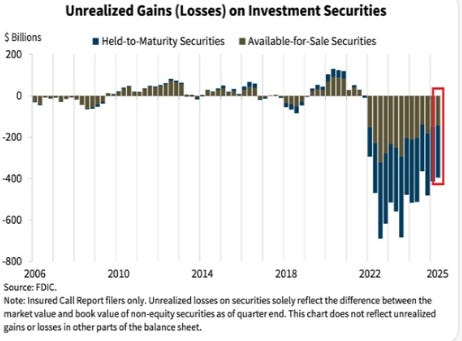
Source; FDIC