

G2 Ping Pong

Markets see the Summit so far moving in favor of US Tech and less in favor of China. In the pre-market semis, Tech and financials are up, while Chinese bellwethers, Baba and KWEB, are down by 3 percent.
While Xi’s warning about Taiwan is stern, TSM ADRs are gaining, and Kospi and KOSDAQ had a strong session, potentially all fueled by Nvidia’s “rumored” H200 deal with Chinese companies.
The Semis trade stays firm on Nvidia’s stronger‑than‑expected H200 and B200 order visibility, a hyperscale pull‑forward of Q3/Q4 demand, and early signals that Blackwell supply constraints are easing.
As such, systematic funds added AI exposure as Tech volatility fell, CTA models flipped from neutral to mildly long, and retail options flow turned bullish (call‑skew steepened).
The energy debate over how to resolve the Strait of Hormuz issue received more attention from US officials than from Chinese officials. The US expects China to play a more influential role in the mediation. This matter has been discussed, but so far, China has not made any commitments to do so.
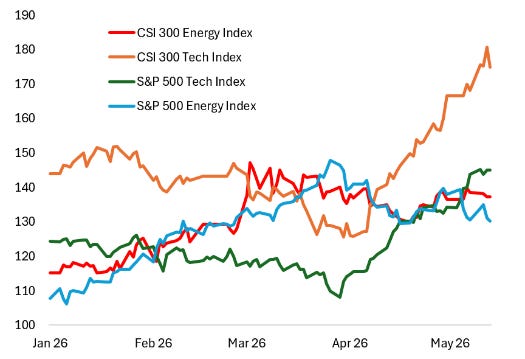
A Chinese oil tanker managed to ‘sneak’ through the US naval blockade—perhaps as a diplomatic gesture by the US—but it is not yet considered a breakthrough in the current stalemate. Thus, markets will continue to trade based on ping-pong diplomacy between the US and China, and, on that basis, China is winning in both tech and energy performance (Figure 1).
Figure 1: China and US: Tech vs. Energy
Source: NYSE, Shenzen, MSCI
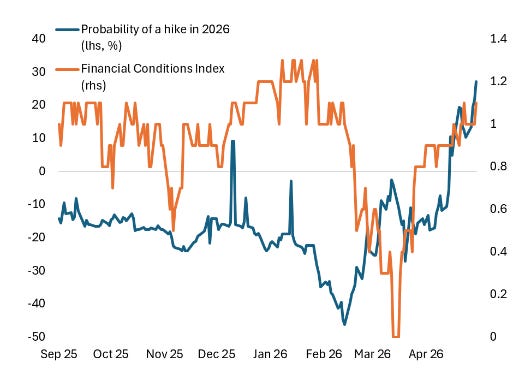
This ping-pong dynamic between China and the US also accomplishes looser US financial conditions, while the odds of a rate hike in 2026 continue to rise. Trump does not want to give up the US Naval blockade, which keeps the Strait in a chokehold and keeps energy and related commodity prices elevated.
At the same time, the AI race between the US and China is driving US semis stratospheric, while energy cannot adequately cool off if China does not get more meaningfully involved in the dialogue with Iran.
The net result is looser financial conditions that can ease further as rate hikes are priced in, serving as a preemptive measure against rising inflation expectations and allowing the Fed to stay on hold.
Figure 2: Financial conditions and odds of a hike (%)
Source: Federal Reserve, CME
However, regarding that idea, Boston Fed’s Collins made a point that inflation can reduce the Fed Funds rate when accounting for inflation; this is the “real Funds rate.” In essence, rising inflation, even with rising chances of a hike, can make policy less restrictive without the Fed acting.
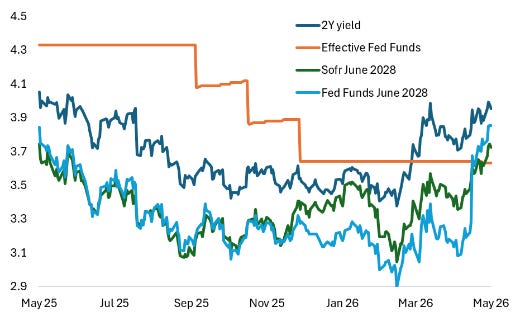
As a result, financial conditions loosen, fueling the speculative parts of the market in call options, leveraged ETFs, and what investors now consider “safe”: semiconductors. The 2Y yield is trading 33 basis points above the effective Fed Funds (the midpoint of the target range), but the market—SOFR and Fed Funds futures—prices a more benign scenario (Figure 3).
Nonetheless, the odds of an easing-and-tightening cycle are 50/50, which is the “good scenario” because markets do not see the Fed as having to surprise by stepping ahead of the current surge in CPI and PPI, avoiding the “behind the curve” narrative that pummeled stocks and bonds in 2022.
Figure 3: Fed expectations (%)
Source: CME, US Treasury