

Indefinite Oil

There is a price for anything, so there is a price for Greenland, based on the “GDP multiple,” historical benchmarks, natural resources, and fiscal valuation. The valuation could be as high as $225 billion based on a historical figure: President Truman offered $100 million in Gold for Greenland in 1946, which, in today’s dollars, is $1.3 billion.
Natural/strategic resources and fiscal valuation, however, are substantially higher: Denmark provides $770 million in budgetary grants, discounted at 3-4%, which has an implied value of $20 billion. In comparison, Greenland’s natural and strategic resources are estimated at $50-$200 billion.
The price tag to pay is hefty, but the Greenland asset is too strategic.
The same is true of 30 to 50 million barrels of sanctioned Venezuelan oil sales, which become ‘indefinite ’ with some sanctions removed; previously exported to China, they will now be “given” to the US and sold to other countries at the fair market price.
Previously, Venezuelan Merey crude was offered at a $13/bbl discount to ICE Brent to China, with some sellers offering $10 to $11/bbl to Brent according to Bloomberg. The cheap Venezuelan oil is a boon for US refiners—Valero, Phillips 66, and Marathon (jumping now by 3% in the pre-market)—as the discount outweighs processing and feedstock costs.
Brent resumes its decline (-0.3% on the news) after yesterday’s ABC news that the US demanded that Venezuela sever ties with China and Russia and exclusively work with the US on pumping oil. Thus, the US may be pocketing at least a ~$ 45-per-barrel premium if sold at the fair market price (spot Brent, now at $60.52).
Thus, the implied value of the first 50 to 100 million Venezuelan oil barrels could be $1.5 to $3.5 billion, and that figure could grow substantially. At the original estimate of Venezuela’s total reserves of 75 billion barrels, the US could gain over ~$1.5 trillion from oil sales ($15/bbl * 75bn reserves).
That would be a deficit slasher, in addition to tariff revenues, which, if not disrupted by the SCOTUS hearing this Friday’s Opinion Day on IEEPA tariffs, could also add several trillion.
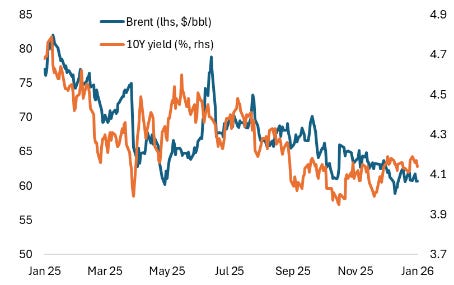
Hence, Treasury yields fell as Brent declined, reflecting expectations of lower headline inflation (TIPS break-evens are down) and the impact on the deficit (Figure 1).
Figure 1: Brent and Yields
Source: Intercontinental Exchange, US Treasury
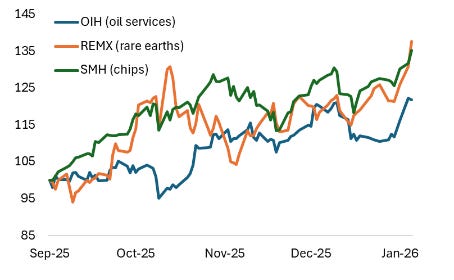
For equities, the interplay between Greenland and Venezuela centers on new market-leading sectors. Year to date, semiconductors still dominate the S&P (industry up 17% driven by other names like Sandisk and Western Digital).
But the new market-leading sectors are oil services/refiners and rare earth miners, which are capturing the current rally (Figure 2).
Figure 2: Oil services, Rare Earths, and Semis
Source: VanEck
The market is affected by supply factors: a shortage of rare earths, minerals, and chips, and an abundant future oil supply.
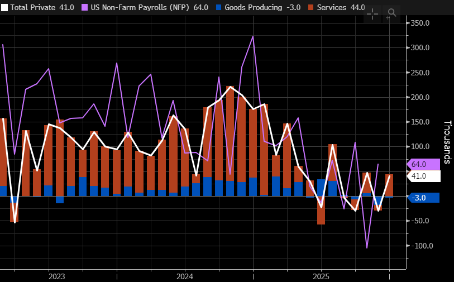
The geopolitics of securing supply for all resources is driving defense spending (~3.5% of GDP), materials, and infrastructure, which tie into fixed investment and drive productivity gains through muted but stable private-sector jobs, especially in defense and construction, at a 3.5K average/month.
As such, the jobs market is in a “bottoming process,” for now, which can add to the goldilocks sentiment at the start of the new year (Figure 3).
Figure 3: ADP and NFP: bottoming
Source: ADP, BLS