

Informed Trading

Whatever US military action is taken in Iran, plans seem to be leaked well in advance, as seen in tweets like these. One reason is that the US may be giving away the first-mover advantage, as the ground operation will be a surprise to Iran, coming from a completely different angle, with the likely objective of fully opening the Strait.
It is an example of “informed trading,” where traders bet on something that is entirely predictable. One could be sure that troops would be deployed in the conflict, or they would not have been moved into the Gulf.
The President is transparent about what will happen if talks with Iran fail, the Strait does not open, and Kharg Island is seized, which certainly involves the 31st Marine Expeditionary Unit (31st MEU), deployed aboard the USS Tripoli as part of the Tripoli Amphibious Ready Group.
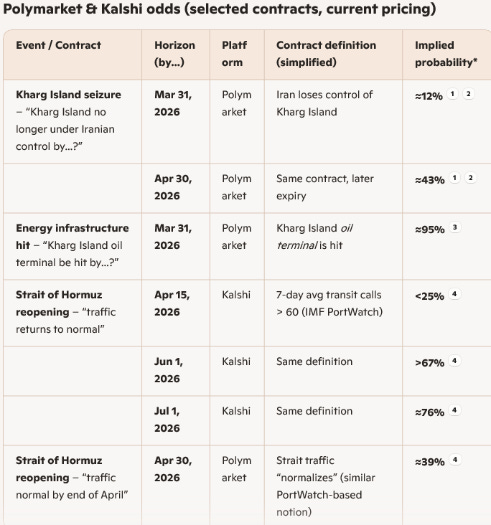
The Polymarket and Kalshi stacks show a notable increase in the odds of the Strait reopening by July, nearing 75%. Simultaneously, the odds of military action by tomorrow, mid-April, are also nearing 75% (see Table 1).
Table 1: Odds of the conflict based on prediction markets (%)
Source: Polymarket, Khalsi
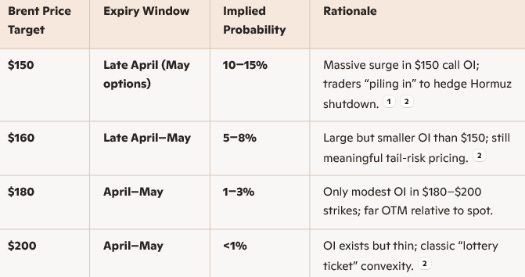
In oil markets, the odds of Brent reaching $150-$200/barrel are 10-15% for $150 by April-May, but less than 1% for $200/barrel, which is associated with a prolonged closure of the Strait (Table 2). Crude markets have been the key driver of expectations for the Fed (and other CBs), which, in turn, have driven yields higher.
As the odds of oil reaching extreme pricing recede, it should also bring down the odds of a hike, which happened today; a hike by the fall is now below 35%, but on prediction markets, it is 22%.
In other words, yields may peak around 4.5% for the time being, as forward-looking indicators such as consumer confidence and the ISM will begin to reflect the effects of the energy shock.
Table 2: Odds of $150-$200 oil
Source: Intercontinental Exchange
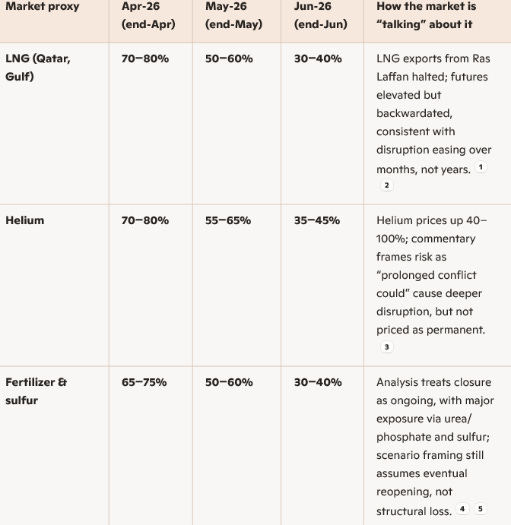
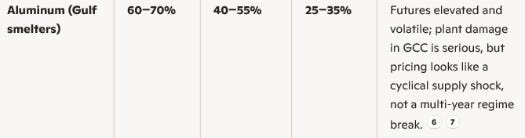
In other commodity markets, such as aluminum, helium, fertilizer, and LNG, the odds of extreme pricing driven by expectations of an extended Strait closure are higher.
The FedWatch LLM estimates that several commodity markets have high conviction. “closure through April”: All four complexes are still trading as if a meaningful reopening before the end of April is unlikely.
The scenario then turns knife‑edge in May: commodity price curves line up with a middling scenario—closure still more likely than not, but with rising odds of partial normalization.
But by June, expectations are for partial reopening: pricing across LNG, helium, fertilizer, and metals is not consistent with a fully closed Strait through end‑June; markets are effectively saying “tail, not base case” for a truly long‑term closure (Table 3).
Table 3: Commodity Odds of the Strait Closure (%)

Source: FedWatch LLM, open-sourced, Gemini, and OpenAI
Based on informed trading (prediction markets), the chances of a rebound are priced in, and commodity markets are (potentially) confirming this. The challenge, aside from unexpected twists in conflict, is near-term inflation.
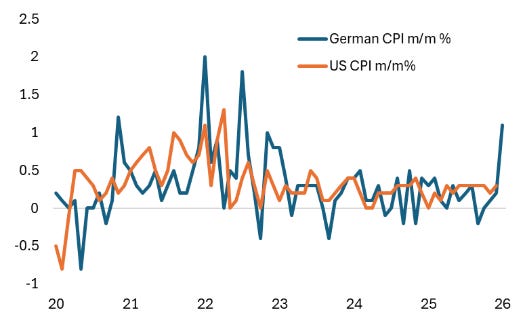
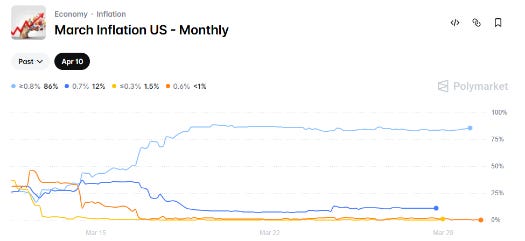
As a first gauge, German headline CPI jumped by 1.1 percent on the month, one of the first major developed-market inflation readings in the wake of this month’s surge in energy prices (see Figure 3). The prediction markets are certain of a major jump in CPI as well, with odds of a monthly change greater than 0.9% close to 100% (Figure 4).
Since this outcome is now fully priced into the CPI swaps market, and Powell did not offer any groundbreaking views on inflation (albeit he said the Fed would wait to assess effects rather than looking through), yields may continue to reduce Fed expectations for rate hike(s).
Figure 3: Germany CPI and US CPI (m/m, %)
Source: Bundesbank, BLS
Figure 4: CPI March m/m%: prediction markets
Source: Polymarket