

Iranian Surcharge

The list of companies announcing a surcharge is growing daily. USPS, FedEx, UPS, trucking carriers, and United Airlines are passing higher energy and transportation costs directly to customers through fuel surcharges, higher freight rates, and higher airfares — all explicitly linked to the Iran war’s impact on oil and diesel prices.
The NYT opens with a telling article that the food industry is also applying surcharges, especially related to the cost of diesel fuel. The Agriculture Department stated that more than 83 percent of agricultural products and 92 percent of dairy, fruit, and vegetable products are hauled to restaurants and grocery stores.
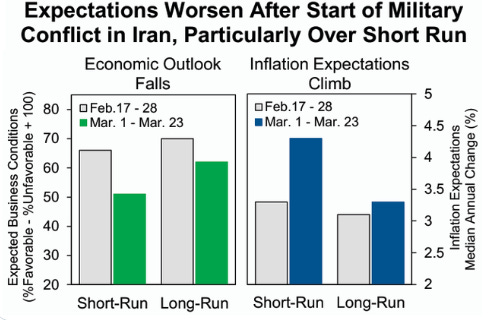
Since surcharges resemble a tariff, potentially a one-time levy, CPI for food at home and away from home is bound to rise significantly; combined, this category accounts for 18% of the CPI Index. Consumers know that inflation is hitting home. The Michigan Survey and the Conference Board report show that inflation expectations are poised to jump (see Figure 1).
Add in overnight’s European CPIs, which are the precursor for next week’s US CPI, saw a big 1%+ m/m change across the board, exclusively driven by energy, the “Iranian surcharge”—i.e., keep the Strait closed, which caused oil and LNG prices to jump—is going global.
Figure 1: Michigan Survey on the war
Source: University of Michigan
With inflation back on the mend, Powell’s comments yesterday took a sanguine tone on the longer term, although he did say there is a need for vigilance; markets also quickly judged that rapidly rising prices risk recession.
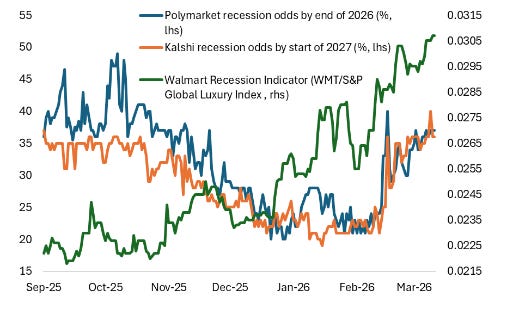
The prediction markets, the informed trader, have odds of a recession by the end of 2026/early 2027 around 35 percent, which is about 20 percent above the NY Fed’s recession indicator average.
The Walmart recession indicator—ratio of Walmart stock to the S&P Global Luxury Index—has also risen. But this recession signal depends heavily on global luxury, which is now negatively affected by the war in luxury Mekka’s like Dubai and the UAE.
Walmart has not imposed a consumer-facing surcharge tied to the Iran conflict. But the company has historically used supplier surcharges (fuel and pickup fees) during periods of elevated transportation costs, most recently implemented in 2022 during the Ukraine-prior fuel‑cost spike.
Once Walmart also goes for a surcharge, many other companies will follow, given the company’s central place in the domestic market and supply chain.
Figure 2: Walmart Recession Indicator (ratio) and prediction odds (%)
Source: Walmart, S&P Global
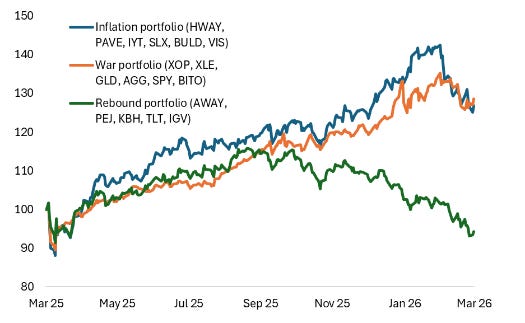
So, in addition to the war portfolio (overweight XLE/XOP and add GLD and a mixture of bonds, large caps (hedge against inflation), and crypto), there is an inflation portfolio to consider.
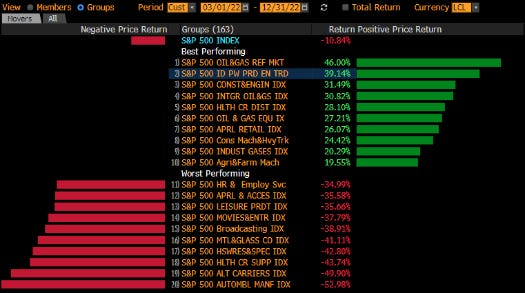
In 2022, sectors that performed well due to margin expansion from inflation pass-through were agriculture, machinery, construction, engines, industrial products, and heavy trucking (see Table 1).
The inflation and war portfolio will switch in leadership as the wave of CPI prints comes out in the next few weeks. While betting on the rebound remains super tricky, such exposure can be hedged with the inflation portfolio, which is likely to perform well over the next few months.
Table 1: 2022 S&P sector winners/losers during inflation surge
Source: NYSE
Figure 3: Inflation, War, and Rebound portfolios (normalized)
Source: Ishares, VanEck, Proshares