

Labor Zero Bound

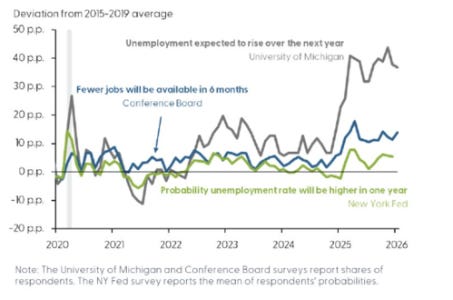
The Fed is concerned about jobs, and Mary Daly’s post underscores why. There is a risk that labor tips into a no-hiring, more-firing environment, with inflation still above the target. It’s a precarious outcome, and consumers anticipate a rising unemployment rate as finding a job becomes increasingly difficult (Figure 1).
At the center of this are the revisions — the benchmark and the birth/death model (which includes new business formation and job growth, not closures). The total downward adjustment could be close to 1 million, which could push payrolls to the zero bound.
Figure 1: Consumer Expectations of the labor market
Source: San Francisco Federal Reserve
According to some economists’ estimates, the uncertainty of the size of the revisions could move payrolls by 40k in either direction. It could affect the unemployment rate in a subtle but important way, as the underlying population and employment levels have changed.
The unemployment rate itself comes from the Household Survey (CPS), but benchmark revisions primarily affect the Establishment Survey (CES). Still, the revisions can indirectly shift the unemployment rate through several channels.
Every year, the BLS benchmarks payroll employment to the Quarterly Census of Employment and Wages (QCEW), a near-census of employers. This corrects for sampling error, firm births/deaths, and structural shifts that the monthly survey may miss.
Even though the unemployment rate comes from a different survey, benchmark revisions influence it because revised employment levels change the implied labor market balance.
The unemployment rate may not change mechanically, but its interpretation shifts: a 4.4% unemployment rate looks worse if hundreds of thousands of jobs are overstated.
The BLS also updates CPS population weights (based on Census Bureau estimates). These adjustments can change the number of people counted as employed, unemployed, or in the labor force.
When BLS updates seasonal factors, the entire historical series for employment, unemployment, and labor force participation can shift. This can slightly raise or lower the unemployment rate, and the effect can last several months.
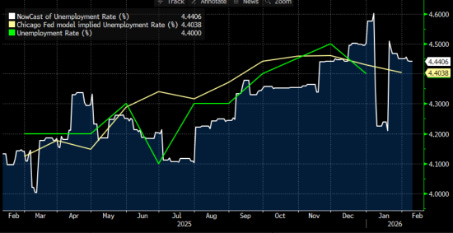
The NowCast model of the unemployment rate “predicts” 4.44%, whereas Kalshi odds show a 37% chance that U3 is above 4.4%, but the Chicago Fed model implies unemployment is 4.4038%. Based on this range (4.44% to 4.04%), the Fed Funds rate is 3.75% to 3.98%, suggesting a hold through the March meeting.
Figure 2: Unemployment Rate scenarios (%)
Source: Chicago Fed, BLS, Bloomberg Economics
Labor market fragility is emerging, with nearly all job gains coming from a single sector—education and health services—while labor force participation among native-born workers has declined and immigration flows have softened.
While these are “known” facts, what remains unknown is the precise inflection point in the unemployment rate at which payrolls break the zero bound to the downside.
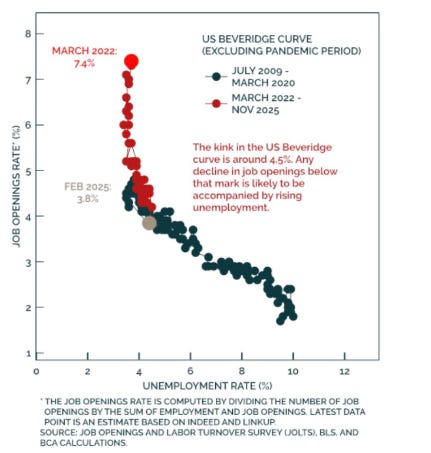
Based on the latest estimate of the Beveridge curve —the relationship between the job openings rate and the unemployment rate—shows that the labor market is at a kink: just a few tenths lower in job openings could lead to a material jump in the unemployment rate (Figure 3).
Chris Waller has made solid calls on policy, using the Beveridge curve as his compass: in good times, he suggested rate hikes early when the job openings rate was rising; conversely, he is now calling for rate cuts, as his analysis indicates that companies are reducing job openings materially.
The PMI indices and JOLTs imply a dropping hiring rate and, as such, a reduction of job openings. The Conference Board CHRO Survey found that 20% of U.S. companies plan to slow hiring in 2025-2026, nearly double the share in prior years.
This NFP report may print positive— FedWatch NFP LLM model “predicts” 45K and U3 at 4.375% — but the revisions could foreshadow negative prints.
Figure 3: Beveridge Curve
Source: BCA research