

Negative Credit Spreads

Occasionally, markets reward debtors. A few years ago, high-rated, high-quality sovereign issuers like Japan and Germany could issue debt at negative yields out to 10-year maturities. And since the GFC, banks have been able to sell interest rate swaps, which are unsecured, at a yield below that of Treasuries.
Now, the prospect of “negative credit spreads” is becoming a reality in corporate investment-grade bonds. As the WSJ discussed over the weekend, with a front-page follow-up, credit is humming, and some issuers, such as Microsoft, can sell securities with yields lower than those of Treasuries.
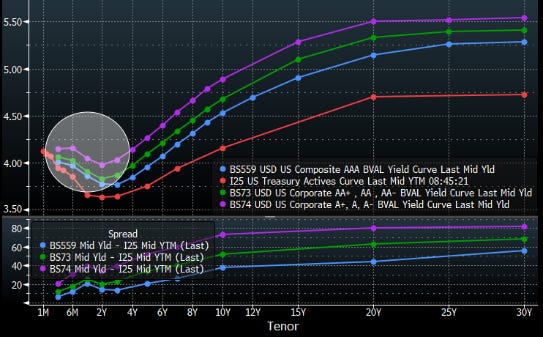
The phenomenon of negative risk premium involves how risk is transferred from one party to another. This is particularly true for US Treasuries in the context of a government shutdown. As such, the yield curves for high-rated credit and Treasuries are rapidly converging, making negative credit spreads a distinct possibility.
Figure 1: Yield curves: Treasuries versus AAA, AA, and A-rated corporates (%)
Source: MarketAxxes, US Treasury
Since 2011, markets have become convinced that brinkmanship in Washington, DC, is good. It works, clarifies, cuts through, and captures the essence of political division as an opportunity to take risks (to quote Gekko). Examples include leveraged buyouts, such as Electronic Arts at $210/share, which represents a 25% premium for a total of $55 billion, achieved at nearly 2.5x leverage.
While this EA deal is not exclusively made because of a political impasse, the timing is curious, coming right before the shutdown deadline that may expire. One reason is that investors seek returns beyond those offered by Treasury debt. If political brinkmanship over the government shutdown intensifies, the possibility of rating agencies putting the US sovereign outlook on watch for a future downgrade becomes more likely.
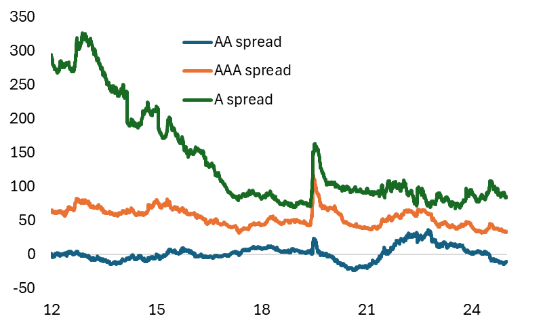
As Treasuries are downgraded to A- (or lower), the credit risk of the US is priced with negative corporate spreads. As a result, financial conditions could become substantially looser, as shutdowns and downgrades affecting employment, as the president is threatening, have historically prompted the Fed.
Figure 2: AAA, AA, and A spreads (basis points)
Source: Barclays/Bloomberg Indices
What is the ultimate consequence and ramification of negative credit spreads?
What happened to negative sovereign yields is a good example. Japanese government bonds were trading at negative yields out to 20-year maturity until 2022, when the BoJ shifted policy.
Then, the interest rate risk (“duration”) of JGB indices reached a record high (~9.7 years), meaning that for every 1% rise in yields, the price decreased by 9.7%. JGB yields have normalized to over 3 percent, and cumulative capital losses exceed 15 percent.
This prospect arises as spreads narrow to a negative number; the credit security will resemble a Treasury, and its duration will closely match its maturity, thereby raising the interest rate risk of credit to the highest level in recent history.
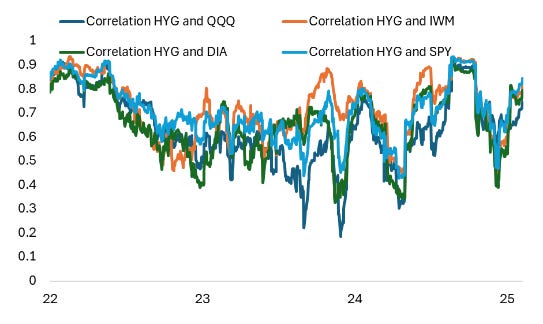
To make matters potentially worse is the equity market’s role in driving spreads. The correlation between lower-rated, High-Yield debt and equities is positive across the board (Figure 3).
If equities remain in a melt-up mode, credit spreads will reach a level at which investors will refuse to buy corporate bonds, setting in motion a “credit normalization” akin to the normalization in sovereign yields.
Figure 3: HYG correlation with equities
Source: Ishares, Invesco, VanEck