

Parabolic Breadth

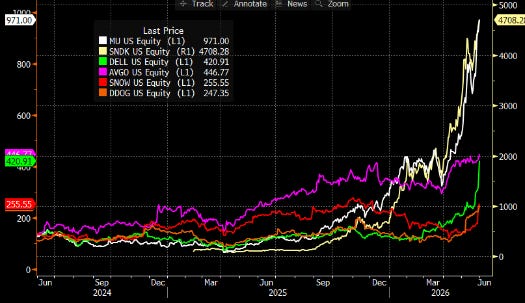
If a word sums up last week’s market action better than the latest shenanigans around Iran, it is the word “parabolic.”
Micron, which beat revenues by 75% in the quarter (196% YoY), saw its gross margin up 30%, and its free cash flow hit $6.95 billion, went into a parabolic hyperdrive, driven by explosive action (+19% post-earnings) in the after-hours. Secondarily, options were attributed (albeit no true gamma squeeze), given heavy volume in short-dated calls around $950-$975 strikes.
There are other examples, like Dell, which had blowout earnings—EPS +214% Y/Y, and AI server revenue up 757% Y/T, and, for example, Snowflake—revenue up 33% with Cortex Code the earnings guide, as well as Datadog—revenues eclipse 34% and expected EPS growth 59% for 2026.
These parabolic moves are reaching extremes (SanDisk), with others following closely, which makes the mathematical chance of one of these stocks “crashing” by nearly 100 percent.
Figure 1: Parabolic moves
Source: NYSE
To achieve such an outcome (individual stock crashes), defining the current market state is essential but difficult. Earnings have become explosive, which some (e.g., Barry Knapp) have dubbed this market an “earnings bubble.”
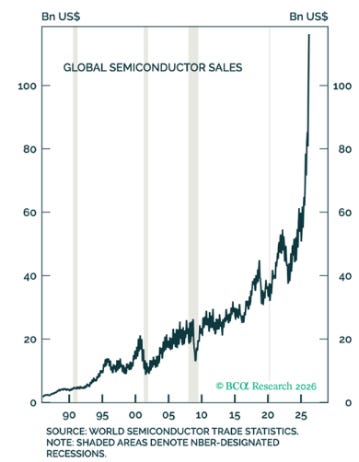
Based on semiconductor sales as one barometer (courtesy of BCA research) of such an earnings bubble, stock prices may not be done with parabolic maneuvers, unless the semiconductor industry suddenly enters a recession (see Figure 2).
From economic data, there seems to be no such thing on the horizon. Volatile durable goods orders were up 7.9 percent on the month, but the report showed defense orders (up 7% to $22 billion due to Iran), with the share of defense in total orders now at 15%.
But non-defense aircraft, capital goods, and non-defense categories were up 21-165 percent (m/m). Trade data showed imports of capital goods up 5.6% m/m (40% annualized), and wholesale inventories of computers, electric goods, and non-durables were up an average of 2.9%, suggesting (re) stocking to meet semiconductor demand.
All these underlying macro factors (albeit lagged or from March) indicate that the S&P blended earnings growth rate of 28% for Q1, of which Tech registered growth north of 54%, means more parabolic moves in other stocks will likely follow, such as potentially post-earnings for Broadcom, CrowdStrike, and Palo Alto this week.
Figure 2: Explosive semiconductor sales ($, billion)
Source: BCA Research
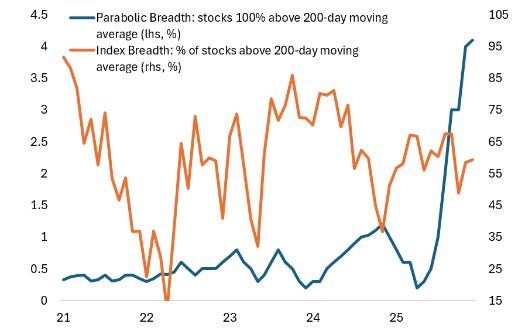
If a company is the sum of its parts, then this market is the sum of parabolic stocks. With their number steadily increasing, call this the “parabolic breadth,” the market’s state of overbought could get a lot more extreme with readings north of 75- 80 on the Relative Strength Index.
As such, parabolic breadth is defined as the market cap of stocks trading 100% or more above their 200-day moving average, expressed as a percentage of the S&P Index’s market cap. Currently, Claude and the LLM estimate this percentage at around 4%, but it has increased explosively since early April (Figure 3). The S&P RSI has since been consistently above 70.
Figure 3: Parabolic breadth versus Index breadth (%)
Source: NYSE
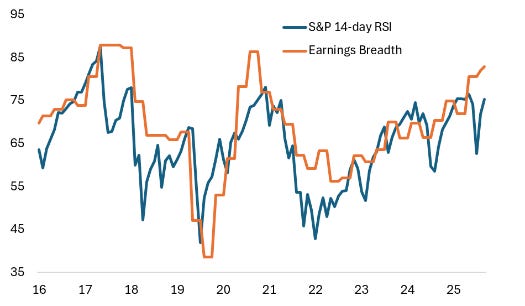
To that end, “earnings surprise breadth” -- the ratio of the number of companies beating earnings divided by the total number of companies reporting--has risen to 83 percent, the highest since 2021. The S&P RSI also tracks this ratio closely (Figure 4).
As a raft of data gets released—ISM, PMI, and (again) durable goods and capital goods, non-farm productivity, payrolls, JOLTS, and ADP- the estimates over May point to further acceleration of activity, likely adding more parabolic stocks to the total sum, raising the chances of individual stock drawdowns.
Figure 4: S&P RSI and Earnings Surprise Breadth (%)
Source: NYSE, FactSet