

Parabolic Seven
The new acronym that is driving market froth

There is a growing sense among investors to “write a reality check.” The parabolic nature of this market is becoming more evident every day as pricing details for the SpaceX IPO are revealed ($135/share, $1.75 trillion valuation at less than 5% float, of which 30% is reserved for retail).
Now the next acronym is born: “Parabolic Seven,” an equal-weighted basket of memory and chip stocks (see Figure 1).
The underlying breakdown of the semi-index, Mag7, and now Parabolic7 reflects performance dispersion among parabolically driven stocks, compared to (now conventional) Mag7s. The rally is concentrated, but increasingly it is carried by a few names from within.
Figure 1: The Parabolic Seven
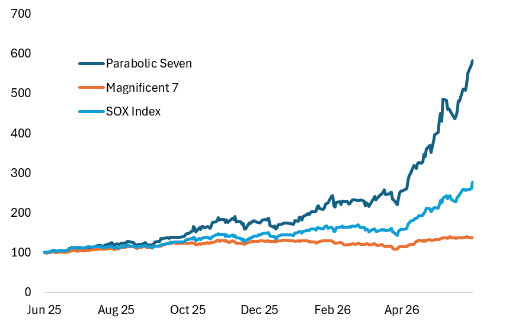
Source: Philadelphia Exchange, NYSE. Parabolic7: SanDisk, Marvell, Micron, Intel, Dell, AMD, and Broadcom.
As such, the market capitalization of Parabolic7 now stands at 8% of the S&P and 11% of the Nasdaq market cap, up more than one percentage point over the last three trading days, a move known as the “parabolic breadth” (Figure 2).
Just a week ago, parabolic stocks represented less than 5 percent of the index. The froth is certainly building at a daily rate of nearly half a percent in market-cap addition by the new seven names/leaders.
Figure 2: Concentration risk (market-cap as % of index market-cap)
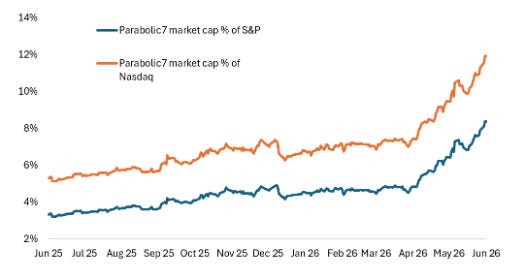
Source: NYSE
The WSJ reports the data center build-out is (notably) slowing due to a supply-chain backlog, as extending delivery times add pressure to the supply chain. The data center construction—as measured by the Census Bureau manufacturing construction—has been consistently falling.
The ISM is increasingly reporting that suppliers expect deliveries to slow, while supply chain pressure is building up, according to the New York Fed’s specific index (Figure 3). JPMorgan research estimates that more than 60% of data-center capacity planned for completion in 2027 is not yet under construction, and another 7% of planned data centers are delayed.
Figure 3: Supply Chain Pressure Index, ISM deliveries, and Manufacturing construction
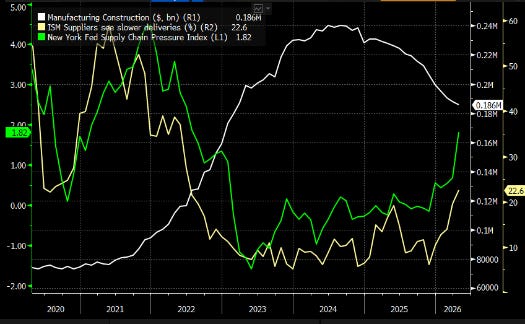
Source: Census Bureau, New York Federal Reserve, ISM
The first shoe to drop is the Parabolic7 if Salomon’s more-greed-than-fear switches; now the President suggests the blockade of the Strait may continue until Labor Day (so no longer a bull case of quicker reopening), and private credit risks reenter the narrative.
The parabolic stock rally will continue, even though the RSI is now approaching 85, an extreme reading (Figure 3). Historically, many parabolic stocks have drawn down by more than 45 percent, compared with the broad indices, which have drawn down by around 25 percent over the past five years.
Markets, though, like trading acronyms (e.g., FAANG outperformed the S&P in 2020-21, a froth period), so this time it is likely not different. But 2021 also shows that FAANGs were subject to FIFO, as that index corrected first in November of 2021 when the Fed signaled a faster tapering.
With the Fed increasingly alarmed about inflation due to an extended lack of resolution in the Iran conflict, which may prompt a consensus signal for a hike, the Parabolic7s could be first out, too.
Figure 3: Parabolic7 RSI
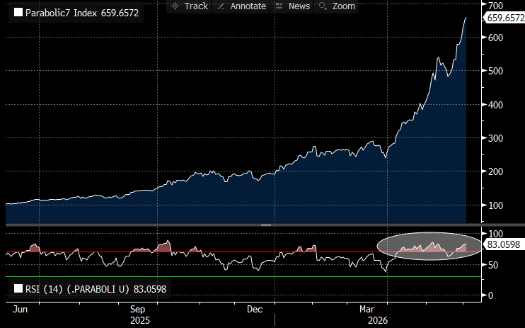
Source: Bloomberg, NYSE