

Psychological Warfare

The President’s post suggests there was a two-way dialogue between Iran and the US. But the deadline for strikes tonight has been extended to 7:44 pm ET on Friday, introducing significant fluidity over the next few days.
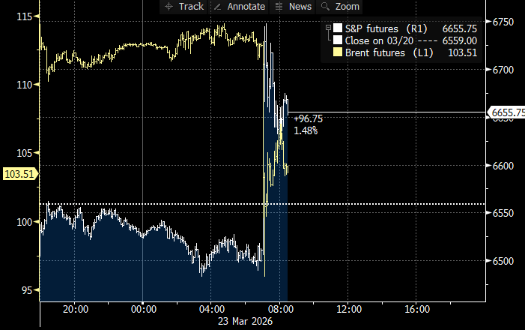
Yet the market reaction — crude drops 9%, Gold rallies 5%, yields fall by 5 basis points, and equity futures up by 2% (airlines up 7%) —indicates investors believe the US is taking the off-ramp to de-escalate the conflict.
But this could be a psychological warfare strategy while more warships move into the region.
Figure 1: Markets’ intra-day reaction: oil versus stocks
Source: NYSE, ICE, CME
Productive talks, however, may not have happened. The Iranian ambassador, Mojtaba Ferdowsi, head of the Iranian Interests Section in Cairo, said on Sunday that there were no direct contacts between Witkov and Foreign Minister Abbas Araqchi, and confirmed that messages are being sent through intermediaries, adding that Iran has not yet responded.
The Iranian news organization Tasnim said there were no talks, confirming the ambassador’s statements. The Mehr agency issued a significant warning: the US proceeding with attacks would cause irreparable damage in the region.
Yet, the ambassador’s phrasing, “messages sent through intermediaries,” is what the communication may have been: no direct contact, but external parties passing US and Iran’s statements.
To reach a truce, Iran set clear conditions, according to the Iranian ambassador: an apology for the assault, payment of compensation, and the United States’ exit from the Arabian Gulf. The Iranian state television stated that Trump’s post is about retreat.
Although there is a risk of smoke and mirrors (because there are no official talks), Trump’s signal could be a more serious attempt to de-escalate.
Similarly, Iranian officials have said that “we are ready to take into account all initiatives made by regional and international parties to end the war, and to ensure that there is no new aggression.”
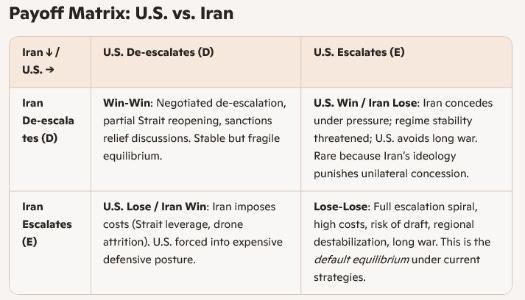
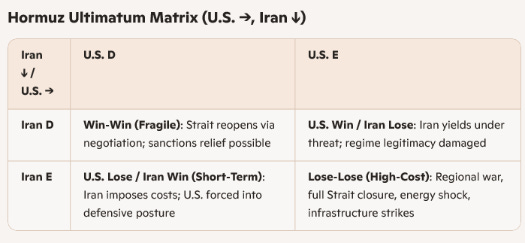
The game theory diagram indicates that if the US moves first to de-escalate, there is a chance of a US loss/Iran win outcome, but a clear risk that the Lose-Lose scenario prevails (Table 1).
Based on Trump’s latest post, the LLM calculated that the probability of escalation remains above 50 percent, while the US lose/Iran win odds are ‘low’ at 15 percent.
Table 1: Gaming out the escalation and de-escalation scenarios
Source: LonLord Industries, FedWatch Advisors
The bounce in markets could fade very fast as psychological warfare can lead to unpredictable outcomes. There is also some historical context to the current crisis.
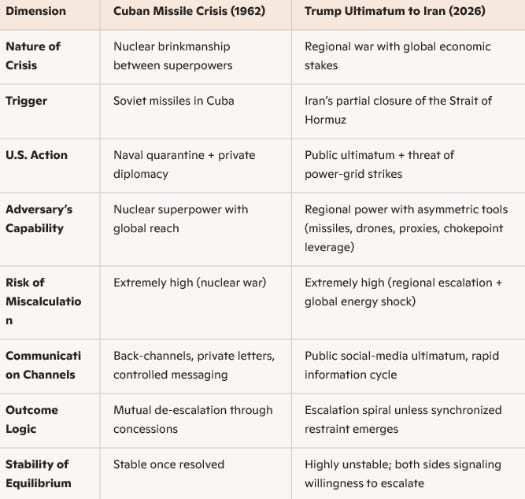
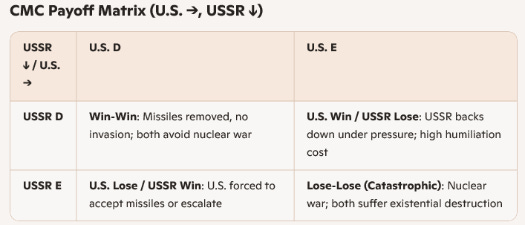
Trump’s ultimatum has some similarity to the Cuban Missile Crisis of October 1962, when U.S. intelligence discovered Soviet nuclear missiles being installed in Cuba. President Kennedy imposed a naval quarantine, demanded the missiles be removed; the USSR insisted they were defensive.
For 13 days, the world stood on the edge of nuclear war, but the crisis ended when the USSR agreed to withdraw the missiles, and the U.S. secretly agreed to remove Jupiter missiles from Turkey and pledged not to invade Cuba. But Russia moved first to de-escalate when then-PM Khrushchev made the first explicit de‑escalatory offer.
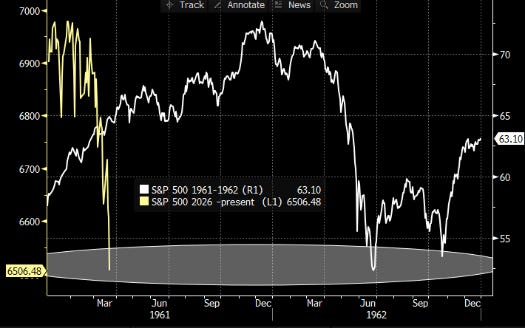
At that point, the S&P was in a 21 percent drawdown, after an initial noisy rebound. Compared to today, the S&P is in a 6 percent drawdown, and may face a volatile rebound until there is a formal de-escalation offer is made (see Figure 3).
Figure 3: S&P 500 1961-1962 versus S&P 2026
Source: NYSE
The signal to de-escalate may be here, but warfare psychology is about how close that de-escalatory moment truly is. With stocks up/oil down, the market assigns credibility to Trump’s signal, which is what the ultimatum may have been all about, just as the Strait closure has not returned to pre-conflict levels.
The danger of misclassification remains if the U.S. treats Iranian noise as a signal and Iran treats a U.S. signal as noise. The 1962 Cuban Missile Crisis is therefore a playbook to keep in mind.
The similarities between the two crises are significant but to achieve a win/win outcome—the most bullish outcome for markets—the US must likely de-escalate formally first to fully open the Strait.
Table 2: Cuban Missile Crisis Comparison
Source: FedWatch LLM