

QuitGPT

With every technological change, there will ultimately be a resistance to change. Such is “QuitGPT,” a grassroots boycott movement urging people to cancel their ChatGPT subscriptions as a form of protest. There are other related movements developing, such as the anti-Meta/Gemini movement, which organized efforts to criticize violations of privacy rights and data protection.
Yet QuitGPT is the first true consumer-driven, social-political movement against AI in the spirit of Occupy Wall Street. So far, there have been 17.000 sign ups on the QuitGPT website, with 36 million views and 1.3M likes on Instagram, where actor Mark Ruffalo has actively promoted QuitGPT. Separately, NYU professor Scott Galloway launched a parallel “Resist and Unsubscribe” campaign, driving additional attention.
The impact on ChatGPT has so far been so small because it would require millions of sign-ups to QuitGPT to put a dent in the 900 million weekly active users. Nonetheless, some of its motivations, such as OpenAI-powered tools used by U.S. Immigration and Customs Enforcement (ICE), were held up in the funding of DHS in the appropriations bill.
In markets, tiny movements like QuitGPT should be monitored for several reasons.
Frustration with ChatGPT’s performance--including complaints about GPT‑5.2 and dissatisfaction with the product’s direction—— could lead to more “code reds” by OpenAI to rapidly develop new versions, accelerate competition with Gemini and others, and further intensify the risk of AI disruption.
In the House and Senate, bills are introduced, such as the AI Workforce Prepare Act (S.3339), introduced by the Senate HELP Committee, that directly address AI‑labor market disruption. The Bill’s purpose is to forecast and plan for AI’s impact on U.S. workers and to provide training, while one of its key provisions focuses on measures to evolve AI capabilities and their automation potential.
While this bill has low odds of reaching the House and the president, it has not been introduced to the Senate floor for a vote. This is nonetheless not slowing other AI-related Bills, such as the AI LEAD Act (S.2937), a bipartisan bill sponsored by Sen. Dick Durbin (D‑IL) and Sen. Josh Hawley (R‑MO).
This bill has been referred to by the Senate Judiciary Committee and is among the most sweeping federal AI bills introduced so far. It would establish legal standards for advanced AI products, impose liability on developers and deployers, and create a federal course of action for AI‑related harms.
Historically, regulation has been the number one killer of asset bubbles (see Erik Gerding’s work on 300+ years of financial bubbles and regulation).
Finally, broader concerns about corporate accountability and AI ethics, including OpenAI’s shift to a for-profit structure, attract more regulation and social backlash like QuitGPT could torpedo OpenAI and Claude subscription models, undermining (potentially) the planned IPO.
The markets are trading towards a major dislocation already seen between software and hardware (Figure 1). QuitGPT is what could amplify the direction; it is a first sign of a crack developing in the AI race.
Figure 1: Dislocation
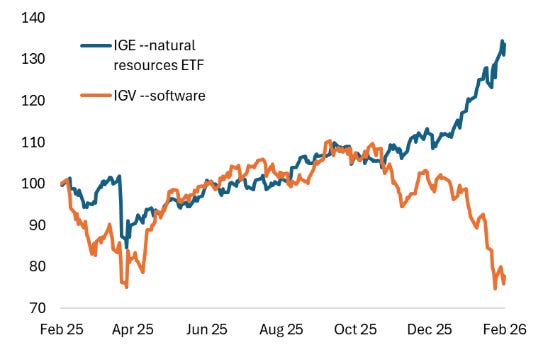
Source: iShares
Go Ben go! Did ChatGBt write this for you? Perplexity? :)