

Refined War Premium
A Diesel Price Shock may not be avoided

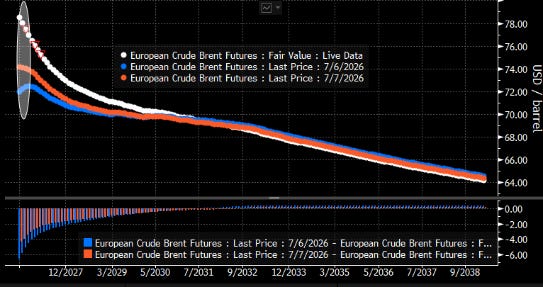
Markets have rebounded because U.S. strikes on Iran have remained short, limited, and far less intense than the February–April Tomahawk, B‑2, B‑52, and HIMARS waves, leaving the current war premium mostly confined to spot crude, which is up about $7 (~10%) since Monday and unlikely to meaningfully affect next week’s CPI.
For now, measured U.S. action reduces the risk of a Kharg Island seizure or a renewed port blockade—events that would shut the Strait—though a U.S. occupation of Kharg, which handles 90–96% of Iran’s crude exports and loads 7 mb/d with 34 mb of storage, would trigger a global oil shock.
The LLM‑based estimates put invasion odds at 5–10%, while prediction markets still price a 72% chance of Strait traffic peaking on July 7, keeping Brent elevated and the war premium intact.
Figure 1: War premium in Brent crude ($/barrel)
Source: Intercontinental Exchange
The refined products risk premium never disappeared, as seen for example in diesel prices that jumped after Russia’s export ban through July 31—imposed amid Ukrainian strikes that disabled roughly 25% of its refining capacity.
That sent European margins to $60.17 per barrel, driving the strongest U.S. diesel futures gain in four years, and pushing seaborne Russian exports down 39% month‑over‑month as markets price a global supply squeeze.
Because diesel is an economy‑wide input, a sustained 10% shock adds roughly 0.08–0.15 ppts to headline CPI through energy, freight, logistics, agriculture, and construction channels, making diesel inflation broader and more persistent than gasoline, even as the diesel–gasoline retail spread narrows to just under $1 with potential to widen as conflict risk rises.
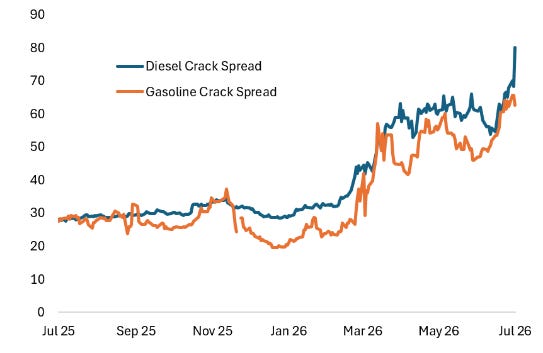
The Strait of Hormuz—through which ~20% of global petroleum liquids and most Middle Eastern diesel‑rich crude flow—amplifies diesel volatility by tightening supply and widening diesel crack spreads, as seen in Figure 2.
Brent moves diesel through feedstock costs, with a 10% Brent increase typically lifting diesel 6–8% and feeding directly into the ULSD–WTI crack that sets U.S. retail diesel prices.
Figure 2: Crack spreads ($, price difference)
Source: NYMEX
Diesel often sits outside the broader market narrative, but a diesel price shock hits Transportation, Industrials, Energy, Materials, and Consumer Staples hardest because diesel is a core input for freight, agriculture, manufacturing, and supply‑chain movement, unlike gasoline‑heavy sectors such as autos and retail.
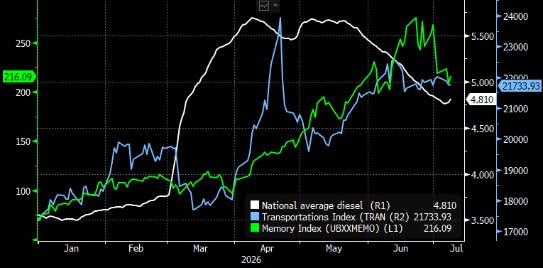
As investors rotated out of memory, chips, and hyperscalers into cyclicals like transport and industrials, a diesel spike could reverse that flow, especially with transports peaking around the April 7 ceasefire, correcting, then staging a modest rally.
Memory stocks, which saw a similarly sharp correction, could even outperform defensively if widening diesel crack spreads signal renewed pressure on transport‑linked sectors.
Figure 3: Diesel prices, transports and memory
Source: AAA, Dow Jones, UBS