

Strait Leverage

Iran keeps leverage over the Strait without using significant military force. Iran gains its leverage from a flexible missile arsenal, remaining at ~1,500 missiles and ~200 launchers after 40 days of war, buried deep underground in the Western Zagros Axis (facing the Iraq / Israel flight corridor).
This region contains the densest concentration of hardened missile tunnels. The Khorramabad/Imam Ali Base, one of Iran’s oldest and most important underground MRBM bases, houses Shahab-3, Ghadr, and Sejjil launch units. It is located 800 miles from the Strait, well within the long-range missile constraint for targeting passing ships.
Iran also has a fleet of fast boats and the capacity to swarm in the Strait. The IRGC Navy (IRGCN) fields dozens of larger fast attack craft (FAC) with anti‑ship missiles, and hundreds of fast inshore attack craft (FIAC) and small speedboats—from lightly armed skiffs to heavily armed high‑speed craft.
The Strait of Hormuz has no true international waters because the entire 21‑nm choke point lies within the 12‑nm territorial seas of Iran and Oman. But it functions as an international strait under UNCLOS, meaning all ships retain the right of transit passage.
For the truce not to become shakier, Iran’s leverage over the Strait is a concern for the Gulf Cooperation Council, which fears the U.S. might accept a deal granting Iran lasting leverage over the Strait in exchange for a fragile truce.
Oil was therefore trading back up earlier today, partly because Iran’s chokehold on the chokepoint sustains physical crude shortages, which swiftly drive up energy costs passed through the supply chain.
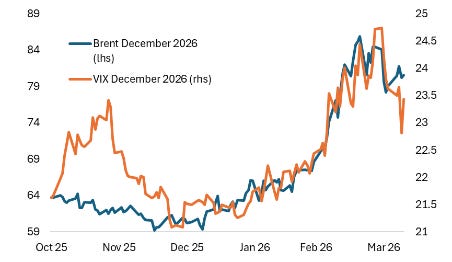
Expectations of future oil prices, as expressed by the “back-end of the crude curve” (e.g., Brent Dec 2026), are locked in the VIX futures expiring in December (Figure 1).
This tight relationship shows the extent of anxiety about the ceasefire’s fragility; as I mentioned to the WSJ yesterday, “Pricing in the market indicates there’s some hedging still required, or a desire to see how this plays out.”
Figure 1: Brent and VIX by the end of 2026
Source: CME, Intercontinental Exchange
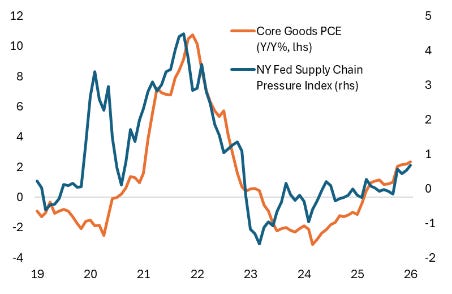
The supply chain, however, is showing early signs of strain, as reported by the NY Federal Reserve’s supply chain pressure index. At the same time, today’s February PCE data showed that core goods inflation hit 2.3% at a 12-month annualized rate, the highest since the fall of 2022 (see Figure 2).
The recent ISM surveys also showed that prices paid jumped by 7 points and were mentioned at least 22 times in the context of inflation. More specifically, the surveys noted higher oil, metals, and shipping costs; tariff impacts; war-risk surcharges; and energy-driven cost pressures.
Figure 2: Supply Chain Pressure Index and core goods PCE (Y/Y%)
Source: New York Federal Reserve, BEA
As the mediation starts on Saturday, Axios reports that Israel will hold direct talks with Lebanon, as part of the ceasefire. While that may lead to a quicker end of the war, the aftermath of the conflict is just beginning. Supply Chain Pressure indicates that the negative supply shock could once again drive up CPI.
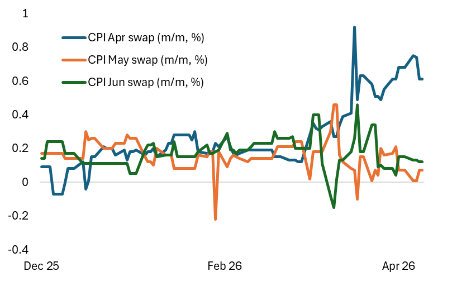
So far, the bond (and stocks) are complacent on the energy shock reverberation; headline CPI monthly swaps show a 0.6% m/m jump expected tomorrow (economists have 0.9% median tomorrow), but for May and June, the monthly change is expected to moderate to 0.3% (see Figure 3).
Tomorrow’s CPI is therefore the kickoff for the macro effects as negotiations begin. The market narrative will likely shift toward fundamentals as it grapples with the damage caused by the conflict.
Figure 3: CPI rolling monthly swaps (release dates of CPI next three months, m/m, %)
Source: DTCC
The Brent-VIX lock is striking, but the cleaner tell is the Brent Dec26-Dec27 spread: backwardation widening past $4 signals the market is pricing physical scarcity, not just vol. Worth noting Iran's FIAC doctrine was battle-tested in the 2015 Marine Corps wargame where a swarm sank a simulated carrier in under an hour — the deterrent value doesn't require the boats to ever leave port. GCC's real fear isn't a deal; it's that transit passage under UNCLOS has never been enforced against a littoral state willing to absorb the cost.