

The AI Iceberg

Markets calmed down because the iceberg of labor market disruption is still in the distance. But from afar, yesterday’s Citrini’s blog is setting a date in the future where Fed policy may have to intervene with a large-scale operation.
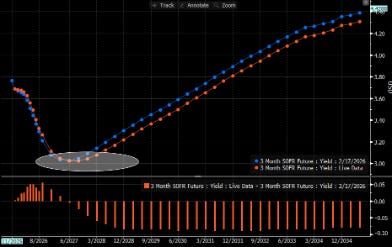
SOFR futures (contracts that price Fed policy) have shifted, now pricing in a new low for the Fed Funds rate by the “Citrini date”—June 2028—when the labor market may hit the AI iceberg (Figure 1).
This means that, near-term, the Fed is anchored and will likely not move unless what is playing out in private credit becomes a meaningful spillover to banks and, thereby, to the economy. Goolsbee emphasized in his speech that labor markets are ‘steady,’ except for low hiring, suggesting financial stress is a risk due to business uncertainty caused by AI disruption and tariffs.
Nonetheless, the Fed is at neutral, as Goolsbee said, because the real interest rate is close to, if not below, the neutral rate. The Fed’s intervention is still way off (2027-28 perhaps), which means the market must figure out a new equilibrium among valuations, AI, and the economy.
Figure 1: SOFR futures shifting post Citrini (oval, %)
Source: CME
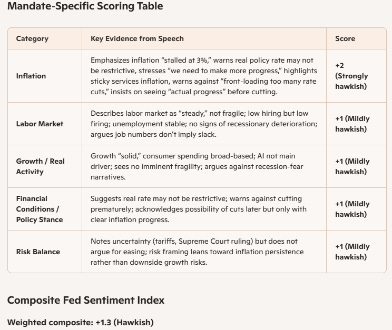
Goolsbee’s speech is therefore remarkably hawkish for his doing, especially as the LLM score is hawkish across themes—growth, inflation, and employment (see table 1).
He doesn’t see an AI bubble, but there could be one. He also acknowledges that consumer spending is affected by the wealth effect in a steady job market, suggesting the labor market is more stable than thought.
Hence, Goolsbee does not see an AI disruption risk, as did Waller, who said yesterday that the Fed has adopted AI in its research process, but it is not replacing Fed economists.
Instead, AI tools make economists more accurate forecasters, and now prediction markets are included in Fed research (see the Fed note here). Today, Cook and Waller address AI and Fed policy, signaling a greater focus as the disruption plays out in markets.
Figure 2: Fed Sentiment score (LLM) of Goolsbee speech
Source: FedWatch LLM
Yesterday, SF Fed Daly also spoke at length about AI and its impact on labor productivity. It was not a groundbreaking speech, but a few nuances may matter, especially if markets become more volatile due to AI blogospheric surprises.
Daly frames AI through the historical lens of electrification and the computer revolution.
The core message: AI will reshape the economy, but not quickly.
Daly also drew a sharp distinction. Automation will occur by replacing old processes with AI tools (e.g., loan application review), and transformation will involve redesigning production, workflows, and business models around AI. But true productivity gains require reimagining the structure of work.
Currently, no fixed AI disruption matrix tells the Fed what to monitor. Therefore, in Daly’s opinion, the Fed must avoid overreacting to hype or early signals.
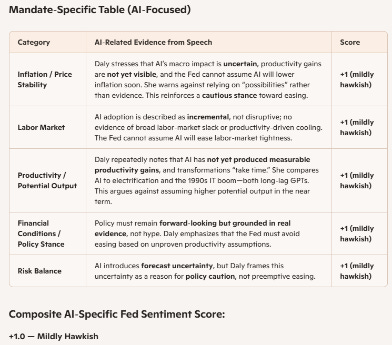
Hence, the Fed’s view on AI is hawkish: labor is not being disrupted by AI as markets fear (e.g., steady claims, weekly ADP).
Rate cuts will be backloaded If warranted, AI disruption headlines have a free hand to cause intra-day volatility without any immediate Fed intervention in sight.
Figure 3: Daly’s speech LLM score; hawkish on AI
Source: FedWatch LLM