

The Bessent Trade

Market psychology has shifted quickly from Trump to the “Bessent trade.” But what is the difference between the two?
Being appointed as Treasury Secretary-elect, Bessent has the same agenda as Trump. He is tasked with furthering the Trump agenda, so those who cheerfully entered the “Bessent trade” should have the exact Trump policy expectations.
Yet, there is a distinct difference.
Treasury yields declined because of anticipation that cutting the deficit from 6 to 3 percent would reduce issuance and slow the economy so that inflation continues its decline, helped by expanding domestic oil production, which lowers energy prices.
So, those actively trading Bessent are betting on lower yields, contrasting those trading Trump on rising deficits and inflation (a 1% rise in PCE is estimated).
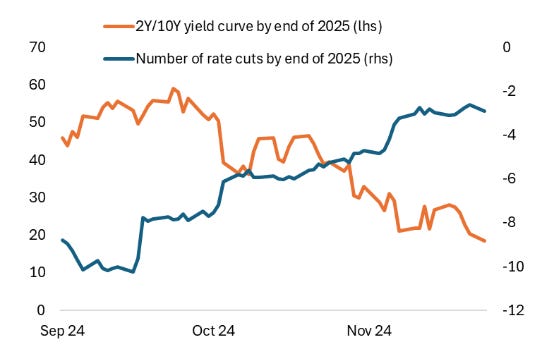
As Kelly observes, the yield curve re-inverts, and markets have been pricing out rate cuts on a more robust economy while the Bessent trade lifts expectations of a lower deficit.
The Trump risk premium of swelling deficits is priced out of the yield curve. This contrasts with expectations that the Fed will not be able to cut rates, as tariffs may lift inflation, and tax cuts lift the economy.
Figure 1: 2Y/10Y curve and rate cuts a year from today
Source: US Treasury
Reducing the Trump risk—i.e., higher inflation and rising deficits—is critical for supporting this market but could also trigger a frothier subsequent stage of the rally.
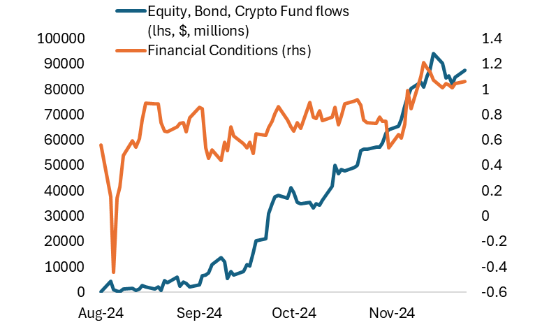
Lower yields create further room for flows into stocks, bonds, and crypto to expand, which can loosen financial conditions beyond 2021 froth levels (see Figure 2). The optimism of a different direction of the US economy elevates market liquidity.
Figure 2: Financial conditions and flows joined at the hip
Source: iShares, ICI, Federal Reserve
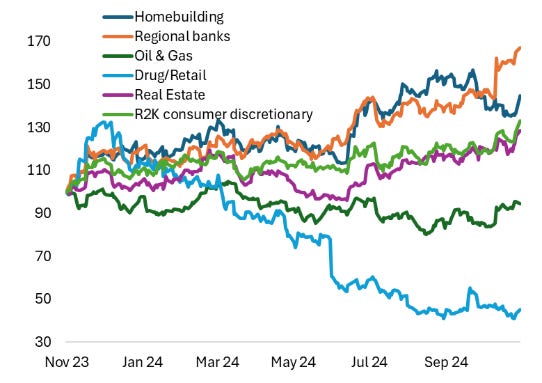
Since November 5th, the Trump trade has been autos, banks/financials, consumer discretionary, airlines, and oil and gas. This changed with the introduction of the Bessent trade, with those at the bottom since November 5th: drug retail, homebuilding, and real estate recovery (see Figure 3).
The Bessent trade further broadens the rally, driven by lower Treasury yields. Markets are treating it like “Abenomics,” as Bessent explained on the Macro Maven podcast; in Japan, a three-arrow policy approach led to change at the BOJ and the public’s view of the economy, which crowded foreign investors into the trade.
Bessent has this in mind to carry out Trump's policy in the second term, igniting portfolio rotations.
Figure 3: Trump-Bessent trades
Source: S&P/R2K
Rotation is the currency of the Trump-Bessent trade. However, Scott Bessent's true impact will be on two whales that continue to shrink in size: the Yen Carry trade and the Treasury Basis Trade.
The Fed’s Financial Stability report noted that the volatility spike in August, aka the Yen carry trade unwind, did not appear to have led to a significant unwinding of the Treasury basis trade but was related to other positions, primarily to meet internal volatility targets.
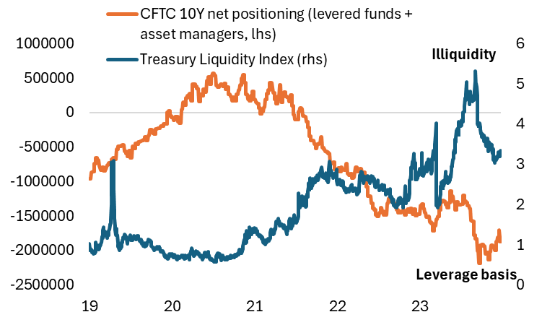
The Fed also (duly) noted that the illiquidity of the Treasury market could amplify the risks of the Treasury basis trade.
The illiquidity of the Treasury market is Bessent’s policy forte, which makes him also preside over the Treasury basis trade through the complex management of the debt deficit and Treasury issuance.
That is the ultimate Bessent macro trade: unwinding leverage built into Treasury positioning by terming out the issuance to shrink the deficit. This risk premium is not priced into the yield curve that is re-inverted.
The glow of Trump-Bessent trades faces a drawdown as Trump's tax cuts and tariffs policy must be dynamically navigated with a new style of debt management.
Regards,
Ben
Figure 4: Treasury basis trade (leveraged positions in 10Y) and Treasury Illiquidity
Source: CFTC, Bloomberg Government Liquidity Indices