


It can take just one strong data point, such as the whopping Philly outlook, to push yields up. The round trip in the longer end is once again about oil and data today, with IG and Treasury issuance lining up for next week.
A strong economy, driven by both fiscal borrowing and investment, leads to higher rates as a matter of economic law. To change the dynamic of rising nominal GDP and rising nominal yields, the law must be rewritten.
So, it is worth noting that the intervention route is used to try to alter the laws of economics.
Yet, when FX intervention—used when exchange rates turn disorderly—and bond‑market intervention—used when market functioning breaks down and term premia overshoot—collide, the attempt to reshape investor behavior sends conflicting policy signals.
Mary Daly noted that long‑end rates reflect structural forces—geopolitics, fiscal sustainability, and now the debt‑financed global AI build‑out—so they offer no guidance on what the Fed should do with policy.
Yields matter as inputs, she said, but price stability is anchored in the short end, where markets clearly understand the Fed’s reaction function, leaving policy “in a good place,” a phrase for a neutral stance often used by Williams and consistent with her strong support for a July hold.
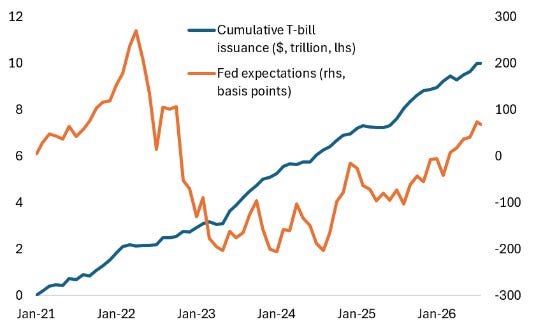
Thus, when Treasury intervenes through buybacks partly financed by additional T‑bill issuance—right where market expectations of the Fed intersect because bills price off Fed Funds—it effectively inserts new bill supply into the very channel that shapes the reaction function, altering how policy signals are received (Figure 1).
Figure 1: Fed expectations and T-bill issuance ($, trillion, cumulative)
Source: CME, Federal Reserve, US Treasury, Sifma
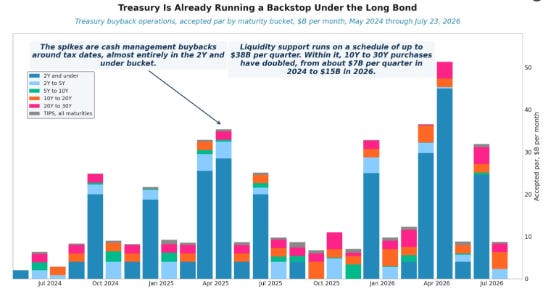
Treasury debt buybacks are not new; they have been running for months, with the long end steadily taking a larger share. But yesterday’s announcement effectively put a spotlight on the long end, turning it into the primary target (see Figure 2).
The tools that Treasury has at its disposal to address the Yen—the currency stabilization fund and the foreign repo facility—have limited firepower, estimated at ~$300 billion.
For debt buybacks, however, the Treasury has $6.5 trillion of current 10Y to 30Y Treasury bonds available, of which the Fed owns about 30 percent. Bessent could increase debt buybacks on the fly and that could “cap” yields around current levels, but there is not a free lunch.
Figure 2: Rolling Buybacks ($, billion)
Source: Lighthouse Macro, US Treasury
T-bill issuance could increase because debt buybacks are treated as cash outlays. Based on the total current market value of outstanding long-end Treasuries accounted for the Fed’s holdings, T-bill issuance could increase by $1.2 trillion should Bessent choose to buyback the entire long-end outstanding.
But such a pop in Bill issuance pushes the share of T-bills of the total debt above 25 percent. That is far above the Treasury Advisory Borrowing Committee recommendation (share <20%).
That could make the case the Treasury must consider increasing the size of 10Y and 30Y auctions; a likely maturity extension of the debt. Without a Congressional mandated sequestration of fiscal spending, the only way to control the deficit and $40T in debt is by extending maturity.
It is a sharpened sword of Damocles hanging over the Treasury market, because maturity extension—attempted unsuccessfully in 2023 and still not priced—would upend Bessent’s intervention strategy and risk a sharp backfiring in yields.