

The Disrupted CPI

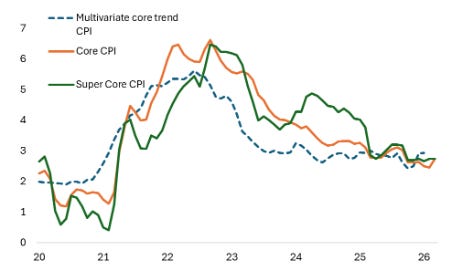
The Fed has a few CPI measures that isolate the index from certain categories to gauge the underlying trend. This multivariate core trend inflation, often mentioned by Williams, stood just below 3 percent in January and will be updated next week (16th).
It is now trending above core CPI and super-core, ex-services, ex-housing, suggesting that underlying inflation was already gaining momentum well before the conflict (see Figure 1).
The trend is your friend until it isn’t, and that is what today’s CPI ‘shocker’ could do to this trend measure, and that matters a lot for Fed policy and consumer expectations in the current environment of energy price spikes.
If the price trend has shifted to a higher plateau, any major shock to CPI could push it even higher (next week’s update will cover February), thereby entrenching inflation expectations at a persistently higher level. In that outcome, the Fed could be forced to pull the interest-rate brake to bend the trend.
With Warsh’s confirmation hearings in limbo, Powell has more time to execute a plan to avoid what happened in 2022. To do so, Powell will likely steer the committee toward adopting a significantly tighter stance at the April meeting (29th), potentially accentuating an “affordability crash” that is already underway.
Figure 1: Trend inflation versus inflation
Source: BLS, New York Federal Reserve
Today’s CPI data is more than just about the impact of energy.
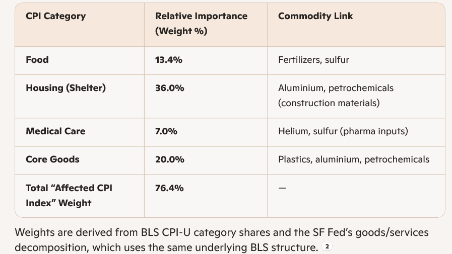
The disruption of the Strait is a multi-commodity supply chain shock, involving fertilizers (urea, ammonia, potash, phosphates), petrochemicals (methanol, plastics feedstocks), industrial metals (aluminum), Energy‑transition minerals (graphite, sulfur), and specialty gases (helium).
Combined, these commodities account for 0% of the CPI’s direct weight, but their effective weight, which reflects their indirect impact through food, housing, medical care, and goods, is more than 20%. This is where the affordability crash hits home especially hard because food, housing, and medical care account for more than 75 percent (!) of household budgets.
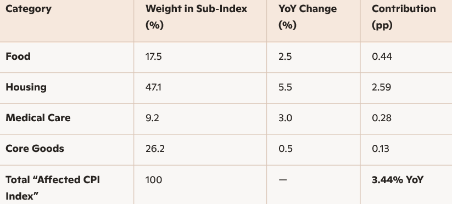
To construct a CPI index isolated to commodities disrupted by the conflict and their indirect impact on household budget items, and normalize their weights, the result is a “disrupted CPI Index” (see Table 1).
In other words, the disrupted CPI is running at 3.44% annualized, in line with today’s forecast for headline CPI (3.4%), but on a month-to-month basis, the change is 0.23%, less than the forecast (0.9%).
Nonetheless, the disruption value represents a third of the monthly change. Since it will take months to normalize traffic and physical shortages, there is a good chance inflation will accelerate over the next 1 to 3 months.
Table 1: Disrupted CPI (Year-over-Year %)
Source: BLS
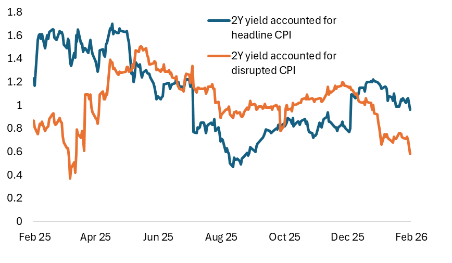
Such acceleration is likely to force the Fed’s hand to return to a more restrictive setting sooner. Currently, the Fund’s rate is around 50 basis points above (“restrictive”) core measures and trend inflation.
But adjusted for the disrupted CPI, little restriction remains. Over the policy horizon, the restrictive stance, as measured by the 2Y yield, is rapidly fading (see Figure 3).
To blunt the second wave of inflation, in my view, the Fed must hike by at least 50 basis points to keep the Funds rate at its current restrictive level. Obviously, this is not priced into the 10Y, the yield curve, high-growth stocks, and the dollar.
But the affordability crash, caused by the squeezing of household budget items mentioned, will worsen in a restrictive rate environment, which can negatively affect the economy.
For now, consumer spending remains brisk, even with gasoline prices rising, driven by tax refunds and wage growth. But today’s CPI will underscore that the Fed must adopt a more restrictive stance.
Figure 3: 2-year yield, adjusted for CPI and disrupted CPI (%)
Source: BLS
The effective weight framing is the right lens here. Worth noting the transmission lag compounds the problem — after the 2022 fertilizer shock, urea prices spiked in Q1 but food-at-home CPI didn't peak until August at 13.5% YoY, roughly a two-quarter delay. If the current disruption follows a similar pass-through timeline, your disrupted CPI may actually understate forward pressure because the fertilizer-to-grocery channel hasn't fully propagated yet. The OECD just revised US inflation expectations from 2.8% to 4.2%, which suggests the market is starting to price in exactly this kind of https://thesynthesis.ai/journal/the-redline-economy.html. Powell's window to act before expectations entrench is narrower than the headline numbers suggest.