

The Jones Analog

Paul Tudor Jones made the case that markets are in a 1999-like state. In that year, there was runaway momentum in technology stocks. Although the Fed raised rates by 75 basis points, the central bank was held back by Y2K and its potential negative macroeconomic effects.
But what 1999 is about is the height of the productivity boom, founded on miracles (Windows ’95 and capital investment). In that year, core PCE averaged 1.3 percent (!), the unemployment rate was 4.2 percent, but productivity was running at 6 percent annually.
Today’s situation is quite different: core PCE is above 3 percent, unemployment is at the same rate, but productivity is running at half of 1999’s levels. So, for inflation, these factors are less Goldilocks-like, even though markets exhibit patterns of surging rallies analogous to 1999.
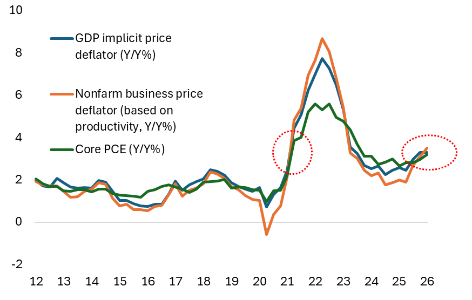
Thus, inflation is rising based on recent GDP and today’s productivity data. The implicit price deflators—the change in prices for all goods and services by comparing the nominal to its real (inflation-adjusted) value—are now above the Fed’s core PCE (!) (see Figure 1).
This indicates that the next surge in productivity is underway, analogous to 1999, as the labor market is showing improvements in JOLTS—more hiring and more quits—which keep jobless claims low. If productivity doubles from present to 1999 levels, Paul Tudor Jones is right: the Nasdaq is getting onto an accelerated path.
Figure 1: Price deflators driven by GDP and Productivity and Core PCE (Y/Y%)
Source: BEA, BLS
Still, since 2020, core inflation has averaged 3.4 percent, compared with 1.6 percent in the mid-to-late 1990s. Supply shocks have become recurrent, and gasoline and food prices have created an economy in a partially stagflationary state of higher unemployment alongside higher inflation borne by the bottom end of the income stack.
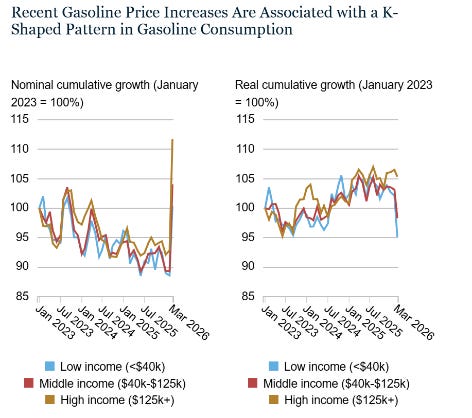
The New York Fed modeled the March 2026 energy shock as creating a sharply K-shaped pattern in gasoline consumption, signaling rising economic stress for low-income workers—especially those in jobs requiring physical presence, commuting, or irregular hours.
Low-income households cut real gasoline consumption by 7%, far more than middle - or high-income groups, even though their nominal spending still rose because prices jumped.
The low-income workforce is entering a period of rising labor market fragility. The sharp reduction in real gasoline consumption — despite higher nominal spending — is a binding‑constraint signal that typically precedes:
· lower labor mobility
· reduced job‑finding rates
· higher involuntary part‑time work
· increased separation risk
This shock raises productivity not because the economy becomes more efficient, but because low-income workers—who are in lower-productivity jobs—reduce their hours and participation.
Hence, the potential productivity surge could directly result from the war: low-income unemployment rises disproportionately to high-income employment.
Figure 2: K-shape effect from gasoline price shock
Source: NY Federal Reserve
The NY Fed has now also just released the latest consumer expectations survey. While median year-ahead gas price growth expectations dropped sharply by 4.3 ppts to 5.1 percent from a spike in March, the 1-year inflation expectations at 3.6 percent are the highest since Liberation Day.
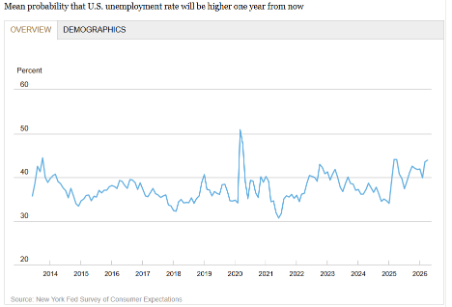
Importantly, the median 5-year inflation expectation rose to 3.8 percent, while expectations of higher unemployment have risen to 2020 pandemic levels (see Figure 3 and Figure 4). These stagflation expectations could be counterbalanced by tighter Fed policy, which Collins describes as the modal scenario (keeping rates restrictive well over the cyclical horizon).
Then, to Tudor’s point, analogous to the Fed’s 1999 hiking cycle, which was an assessment of an economy running hot and risking rising inflation, the Warsh Fed should think about raising rates instead of just thinking about it. Even though energy prices could cool, the Fed may be getting closer to signaling a rate hike as soon as June.
Figure 3: median forecast of 5-year inflation expectations (%)
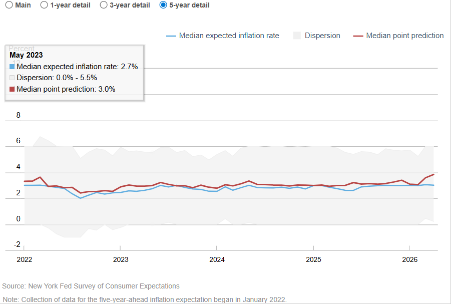
Figure 4: expectations of rising unemployment (%)
Source: New York Federal Reserve