

The Semis Surge

Stock markets “appreciate” war; it significantly drives up GDP, as seen from data over the past week.
Defense-related durable goods were up 18%, new orders for computers and electronics rose 4 percent, and (real) equipment investment in the GDP report showed an annualized gain of 9.6%, matching durable goods’ annualized growth of 9.4 percent.
Defense spending contributes to these gains, but what is unfolding beneath the surface is a surge in tangible assets, directly related to increased demand in the data center and AI segments, which are growing at annualized rates of 22% to 136% (e.g., AMD, Intel, and MaxLinear for data center infrastructure).
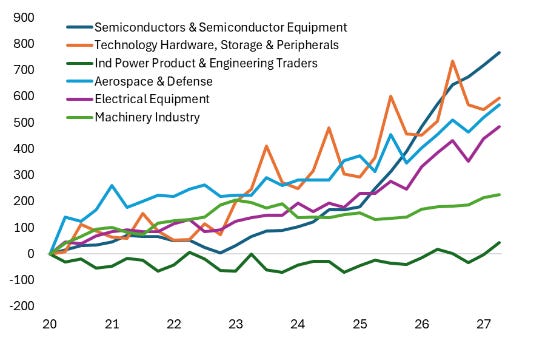
Now the cumulative annualized growth of tangibles is running at over 500% (!) in sectors such as tech hardware, semiconductors, and electrical equipment (Figure 1).
And these trends still seem to be on an unsustainable trajectory, as seen in today’s trade balance data: imports of capital goods also rose to a record, as the buildout of AI data centers boosted demand for foreign-made computer equipment.
Figure 1: The surge: cumulative annualized investment growth (%)
Source: FactSet, Bloomberg, US Census
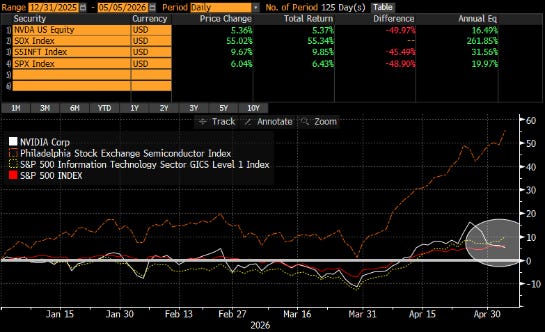
Intense investor focus remains on how the semiconductor surge can continue, especially as its behemoth, Nvidia (which reports on May 20th), lagged the SOX Index by 50 percent year-to-date and even the S&P by 1 percent (see the oval in Figure 2).
In superb earnings season so far---the S&P headline number hit +27.1% blended EPS growth — more than double the +13.1% consensus expected on March 31, and the strongest quarter since Q4 2021.
With 63% of S&P 500 companies reported, 84% beat EPS estimates and 81% beat revenue forecasts. Nvidia is an outlier for now and remains cheap on a forward multiple (trading at a 50% discount to the current multiple).
Figure 2: leaders and laggards (total return, %)
Source: NYSE, SOX, Bloomberg
Earnings show that AI can be divided into three clear macro themes:
AI capex is now revenue — Q1 2026 is the first quarter in which cloud providers explicitly stated that AI enterprise solutions are their primary growth driver.
Tariffs are a double-edged sword —Nucor’s 376% EPS surge is the tariff bull case. But Caterpillar simultaneously cited higher tariff costs as a drag on manufacturing margins.
Semiconductor demand is supply-constrained, not demand-constrained — AMD, TSMC, and NVIDIA all indicated they are selling everything they can produce. AMD has “increasing visibility” through large-scale deployment pipelines.
As the US Treasury Economic Statement to the Borrowing Committee (“TBAC”) noted: “Throughout 2025, AI-driven investment (BFI in
software, computers, hardware, and data center structures relative to pre-LLM trends) accounted for over a third of GDP growth.”
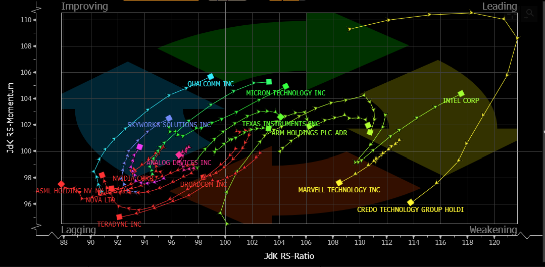
This momentum is set to continue; investment in data centers jumped over 22% (annualized) during the first quarter. High performance of the semiconductor sector is projected to persist, accompanied by increased rotation aimed at establishing new industry leaders (see Figure 3 for details on leading companies, such as TXN, ARM, and Micron).
While small-caps, banks, and related cyclicals showed good competition, the investment economy is likely to add to gains in semis, transports, telecom, and even energy services (already up 15-55% YTD).
Figure 3: SOX rotation: gaining momentum
Source: NYSE, SOX, Bloomberg Rotation Index