

Ticking Clock

With new threats from the President to push the negotiations forward, Iran remains dug in on its terms. Pakistan’s Interior Minister Mohsin Naqvi held 90‑minute talks with Iran’s President Pezeshkian in Tehran, discussing how to restart U.S.–Iran negotiations and stabilize the ceasefire.
A resolution remains possible, as the US appears to have temporarily lifted OFAC sanctions on Iranian oil (for Chinese refineries), although the US has not confirmed this.
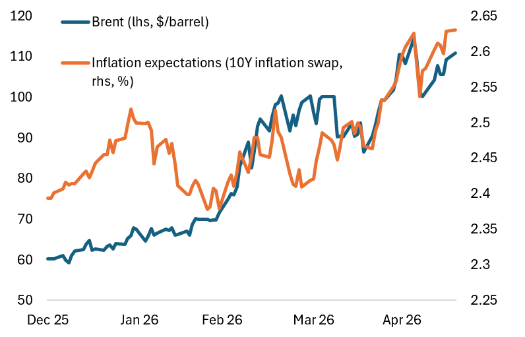
These geopolitical shenanigans come at a moment when Brent crude edges (again) towards the critical $110-$120/barrel range, where jawboning or signals of ending the war ‘soon,’ moving the negotiations forward, or extending the ceasefire have often occurred.
Inflation expectations and Brent are in lockstep, and since February, more than half of the rise in the 10Y yield (about 60bps from the February low) can be explained by oil prices and inflation swaps (see Figure 1). Thus, any jawboning by the US, Iran, and the G7 aims to reverse the rise in oil prices.
Figure 1: Inflation swaps (expectations, %) and Brent crude ($/barrel)
Source: ICE, CME
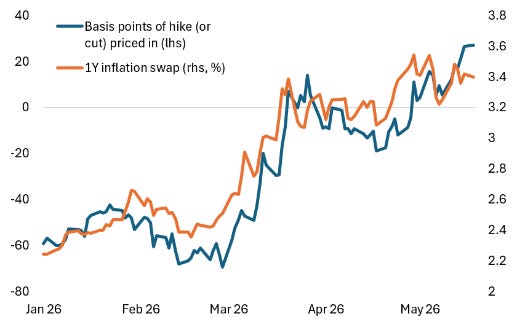
Considering the energy shock is driving headline inflation, future rate hike(s) are directly keyed to short-term inflation expectations: e.g., the 1Y inflation swap and the implied number of basis points of a hike by March 2027 are also in lockstep (Figure 2).
For every 1 percentage point change in expectations over the course of a year, the market prices in a full 25-basis-point hike over that period. The linear relationship between inflation and rate expectations is important for market direction, including how the G7 may address today’s rise in yields.
Figure 2: Inflation swaps (expectations, %) and basis points of hikes priced in
Source: ICE, CME
The chances of an actual intervention by the G7 remain low because of practical constraints and expectations of some resolution; central banks would have to coordinate bond purchases, and the question is which sovereign bond market to focus on (Treasuries? Gilts? JGBs?).
At the same time, the chances of conflict resolution remain high because political interests and low approval ratings affect the odds in the midterms.
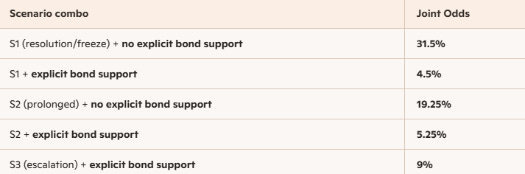
The joint probability of no G7 intervention and conflict ending exceeds 30 percent (see Table 1). Those remain lofty odds, a condition entrenched in market psychology, and why any drawdown near 10 percent will be bought.
Table 1: Joint probabilities of intervention and conflict ending (%)
Source: FedWatch LLM, OpenAI
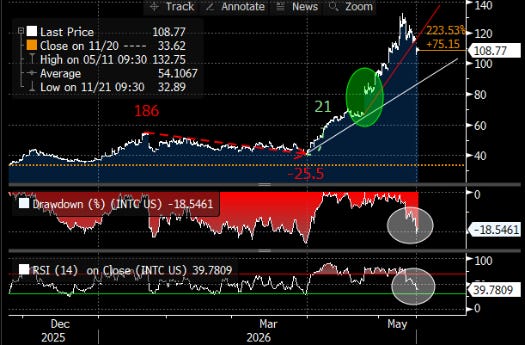
The Nasdaq’s drawdown from its peak is about 2.5 percent, which is very modest so far. But for Intel, which supercharged the recent semi rally, the drawdown is already 18% (!) (see Figure 3).
The stock is not even oversold, meaning that if the signal-to-noise from the US-Iran chatter is once again drowned out, a further drawdown in equities is expected to remove extreme overbought conditions.
Figure 3: Intel rally retreats
Source: NYSE
Good thing yields will stay low. Probably.
…