Tripple Witched Rates

The energy shock has secondary effects, including at the front end of the yield curve. Yesterday’s outsized moves in 2Y yields— e.g., a 33-basis-point intra-day swing in the UK—are due to an investor reassessment that a new rate-hike cycle could start by next month.
But where the real action at the shorter end is taking place, the inflation vigilantes are firmly pricing in the energy shock. As such, rate and inflation expectations are making a 180-degree turn in sync.
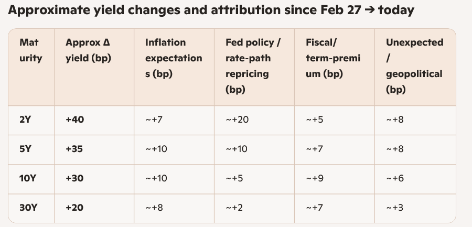
By the FedWatch LLM model estimate, the 40 basis points change in the 2Y yield since February 27th, more than 20 basis points, is directly attributable to the change in Fed expectations, whereas inflation expectations had less effect (Table 1).
Importantly, the long end was driven by inflation and the fiscal deficit, with each contributing 7-8 basis points. This means the Long-bond discounts caused by inflation worsen the deficit, as more US military operations (which cost ~1.4bn/day) drive oil prices higher while Iran continues to retaliate.
Table 1: LLM modeled Yield changes and driving factors (basis points)
Source: FedWatch LLM
While past energy shocks caused a similar shift, the shutdown of the Strait and damage to refineries across the Gulf are causing a supply cost-push shock that can last several years. Inflation could become elevated in the 4 to 6 percent range for headline, with a potential bleed-through core in the 3 to 4 percent
But to Waller, that is not a direct concern.
Although he avoided the T-word, he bases his inflation math on another T-word (tariffs), which, he says, should roll off. Coupled with declining rents, this should offset the impact of energy prices. He revealed the dovish flank in the Fed and its dynamic reaction function: had the war not happened, with the surge in energy prices, he would have dissented for a rate cut based on the -92K jobs number.
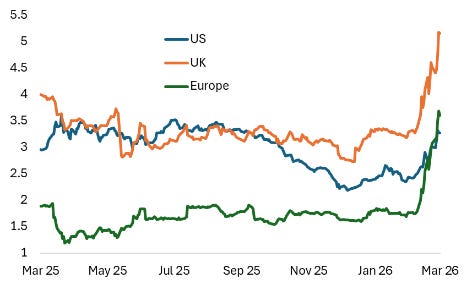
Figure 1: Change in inflation expectations (%) (1-year inflation swaps)
Source: CME, LME
On rates, Waller carries a relevant message: central banks are turning decisively vigilant, which pushes up 2-year yields. The market expects, ex-Fed, that short-term rates will be hiked by 75 basis points over the course of next year. The long end, however, is pricing in a 20-basis-point rise, which makes a yield curve inversion likely in the next 6-12 months.
In the near term, most central banks do not want to slam on the brakes with jumbo-sized rate hikes. That means the long end must carry the central banks’ burden by lifting yields towards 5 percent, a level at which policy becomes restrictive again.
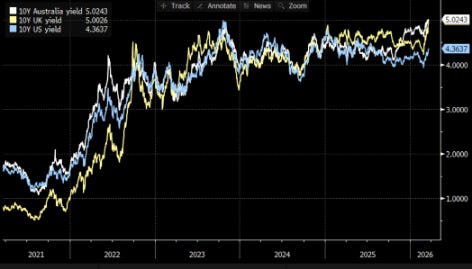
Australia, and soon the UK, are seeing their 10Y yields breaching 5 percent, with the US still lagging (see Figure 2).
It is not entirely unrealistic for the US 10Y to move closer to the 4.5%-5% range, given a sustained energy shock, which will sway the majority of the FOMC to the significantly more hawkish side of the boat.
Figure 2: Global yields (%)
Source: Bloomberg
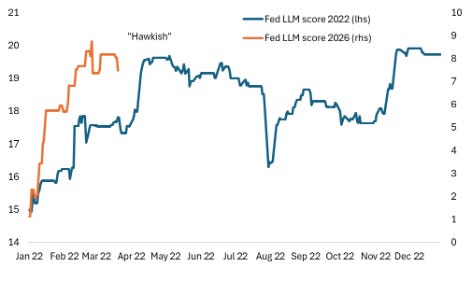
To that effect, the sequence of the Fed becoming very hawkish in its language, as seen in 2022, is playing out again. The FedWatch LLM score for Fed speak has moved into hawkish territory and now follows the 2022 score (see Figure 3).
If the Fed does go in this direction, despite Bowman, Miran, and Waller still calling for rate cuts, the market will flatten the yield curve as much as a pancake, reflecting maximum uncertainty.
Figure 3: Fed LLM score (hawkish/dovish): repeat of 2022
Source: FedWatch
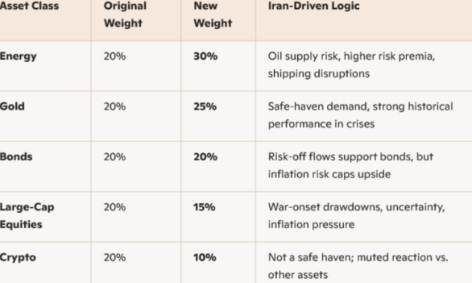
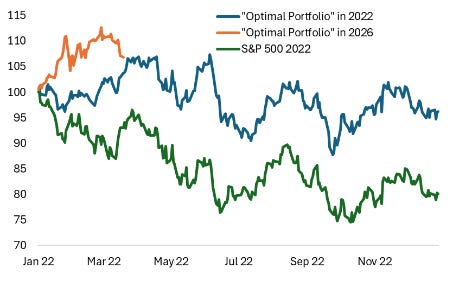
Still in this volatile environment, there are portfolios that do work. For example, if you use only news from Iran and the Gulf as the sole news factor, the portfolio remains more weighted toward energy, materials, gold, and Bitcoin, and underweight stocks and bonds. This portfolio also performed well in a bad year like 2022 (Figure 4).
Figure 4: “Optimal Portfolio” versus S&P: 2022 vs. 2026
Source: FedWatch, NYSE
*Optimal portfolio