

Wrong Inflation Direction

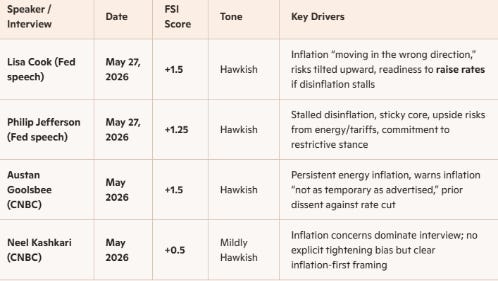
A few Fed speakers expressed a moderately hawkish view, at least in the ‘eyes’ of market pricing. Lisa Cook, Phil Jefferson, Neel Kashkari, and Austin Goolsbee, following up on Waller’s commentary last Friday, expressed significant caution about the direction of the conflict and, by extension, inflation.
The energy shock can only be temporary if the conflict ends ‘soon,’ a prospect that remains unclear and highly uncertain. Most of these speakers advocate a neutral policy for “next months,” suggesting that the easing bias in the June Statement will shift to a neutral stance.
The Fed speakers scored “hawkish” on the Fed Sentiment LLM Index by a margin of +1 to +1.5, which is high. As such, the odds of a rate hike by December rose back above 50 percent.
Table 1: Fed Sentiment Index score of the latest Fed speak
Source: FedWatch LLM, Claude
But Goolsbee and Cook added new conditions to the rate hike(s); each points to the AI investment boom as an additional shock to consumer prices on top of tariffs and gasoline.
Specifically, to date, $1.5 trillion in data-center plans have been announced, with a small portion realized so far; the effects on prices for chips, tech equipment, and software, as well as wages in specialty trades, and electricity and water, could be more substantial.
Moreover, as AI investments expand profit margins, those firms may increase AI capital expenditure, thereby extending the AI investment cycle.
Goolsbee mentioned that it could create “hype” about productivity that risks overheating, and that rates may need to be raised to prevent an overheating of the economy.
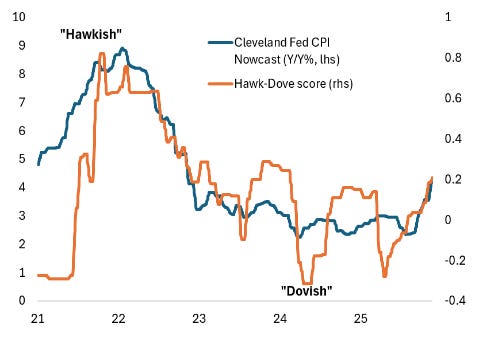
Thus, the hawk-dove scale—the scoring of Fed members as hawkish or dovish—is notably shifting toward a higher hawkish score, though it does not indicate a majority of the FOMC. This score tracks real-time inflation (NowCast), which is highly sensitive to tariffs, gasoline, commodities, and utilities (Figure 1).
Figure 1: Hawk-Dove Score (LLM) and Real-Time Inflation (NowCast, Y/Y%)
Source: FedWatch LLM, Federal Reserve, Cleveland Federal Reserve
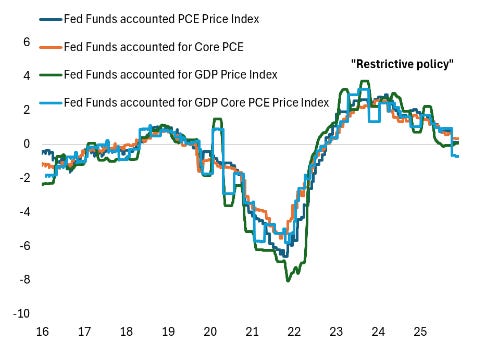
Indeed, real-time inflation is moving in the wrong direction and could risk the Fed falling behind the curve if inflation moves above the Funds rate. In that situation, Fed policy lost all its restrictiveness, and that moment is nearing.
This morning, several PCE Indices were released—PCE price index, core PCE, GDP price index, and the GDP Core PCE price index — which measure the prices of all goods and services purchased and produced in the United States.
The forecasts are 3.3% to 4.3% for the core PCE price index (GDP), driven by services and non-durables, in part due to AI investment and demand, with energy and tariffs on durables adding pressure. At those inflation levels, Fed Funds is barely restrictive to slightly accommodating (vs. the GDP price index as of last quarter).
Inflation has made Fed policy neutral, and it could become an easing policy if the Funds rate remains unchanged while consumer prices keep rising (i.e., a negative real Funds rate).
Figure 2: Fed policy measured against PCE inflation (Y/Y%)
Source: BEA, CME, Federal Reserve
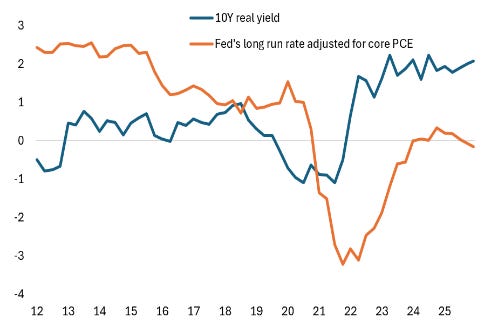
Indeed, the Fed’s long-run rate adjusted for the preferred gauge, core PCE, has rolled over into negative (real rate) territory. The market-based real yield from 10Y TIPS (inflation-linked Treasuries), however, is drifting higher (Figure 3).
One reason is the expectations of growth and productivity, as the neutral rate is likely moving higher due to AI investment, and inflation expectations are close to 2.5 percent. This is a sign that bond markets are carefully pricing the prospect of an overheating economy, which could drive real yields even higher.
With a modest negative real Funds rate, the Fed can signal a rate hike, but it may need to consider embarking on a series of hikes if overheating becomes a reality.
Figure 3: Long-run real Funds rate and 10Y real yield (%)
Source: US Treasury, Federal Reserve