

Year End Fed

Last Wednesday, Williams had a meeting with several Wall Street banks to discuss market liquidity. The venue, the annual Treasury conference, was convenient, but the signal from that meeting was of an ominous quality. The liquidity in US Treasuries is being challenged, and the underlying financing market, known as “repo,” has become volatile.
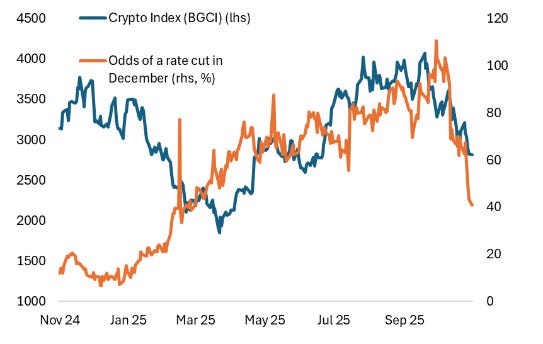
While there are clear reasons at this time of the year, such as banks having to comply with Basel III leverage ratios, there are other reasons for the sudden volatility. Around the end of October and early November, a trifecta of macro factors—FOMC meeting, Supreme Court hearing on tariffs, and CPI—shifted the narrative to risk-off.
The sap of liquidity has spilled over to high-beta assets, including noteworthy crypto, and attacked the AI trade as investors retrenched due to doubts about profitability (Figure 1).
For those reasons, some ‘experts’ recommend reducing the allocation from 25 percent in Gold to 20 percent in cash in portfolios. But falling odds of rate cuts could complicate that allocation because the illiquidity in money markets has offered an opportunity for a near 100% hit ratio after every year-end dislocation.
Figure 1: Odds of a rate cut and Crypto Index
Source: Galaxy, CME
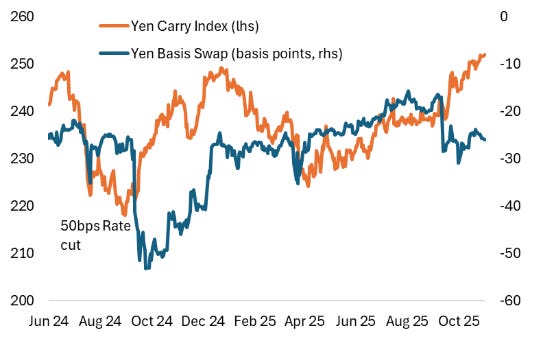
To that effect, the year-end stress is priced in far less than in previous years. A barometer of illiquidity is the currency market, where “basis swaps,” which are contracts where investors can borrow or lend dollars to foreign investors, have begun to widen, but not as much as seen in the August 2024 period.
At that time, the Yen carry trade was unwound through 3x leveraged ETFs on the Nikkei and Topix. The 50-basis-point rate cut by the Fed alleviated market pressure because it was viewed as insurance against near-term weakness.
This time, the two consecutive cuts have become a reason for risk assets to trade risk-off, in part because inflation data shifted the Fed’s message towards slowing the pace of cuts. The strength of private payrolls suggested less concern amidst rising uncertainty over tariffs and AI.
Thus, good economic news is on the horizon, for example, today’s material rebound in the volatile Empire manufacturing sector. The illiquidity may initially increase because the odds of a rate cut are reduced further, until it is viewed as good news.
Figure 2: Yen Basis Swap and Yen Carry Index
Source: CME, Bloomberg Carry Indices
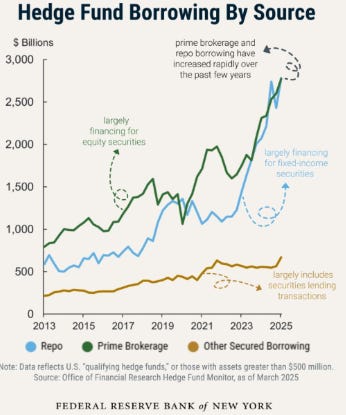
Leverage has become a bigger risk, as shown by the New York Fed in a column on hedge funds. These funds have leveraged both stock and bond positions by an average of three times, with the highest leverage in a decade.
However, the recent volatility in repo and funding has shown that hedge funds may be adjusting their credit lines, and banks are becoming wary. And why the SFR facility has seen a drop in usage.
As the NY Fed article outlines, hedge funds rely on prime brokerage, which is primarily financing for equity securities; repo, which is essentially financing for fixed-income securities; and other secured borrowing, which mainly includes securities lending transactions.
Hedge funds have higher exposure to high-beta, AI, semiconductor, and cryptocurrency sectors than other funds. As the liquidity squeeze is likely to intensify after December 1st, when quantitative tightening (QT) ends, it is currently unclear how many reserves the Fed will reinstate as the Treasury General Account winds down from its current level of nearly $1 trillion.
Fed into year-end will be frontloading volatility in November, especially this week, as the mega data release and retail/NVDA imply an average move of 3.5% for the index.
Figure 3: Hedge Fund Leverage rising
Source: NY Fed